25 min read
7 Operational Patterns That Signal an SNF's Compliance Program Is Running on Institutional Memory Rather Than System
Seven warning signs that your SNF's life safety compliance program depends on one person's knowledge — and what systemic fixes actually protect survey readiness.
By Benjamin Terebelo

There is a version of compliance that looks exactly like compliance until the surveyor walks in. The binders are full. The logs are signed. The fire drills happened. And then the citation comes anyway, because the maintenance director who knew what "monthly generator test" actually required in writing retired eight months ago, and nobody who replaced him understood that the kW load reading was the whole point of the log entry.
This is the central compliance risk that nobody in skilled nursing talks about directly: the difference between a program that runs on institutional memory and one that runs on system. The first kind works perfectly, right up until it doesn't. The second kind works regardless of who shows up on Monday morning.
The seven patterns below are operational signals. None of them require a surveyor to find. They are visible from inside the facility, if you know what to look for. Each one indicates that your SNF's life safety and compliance program is more dependent on specific people's knowledge than on documented, auditable process, and each one describes the point of failure a CMS or state surveyor will find before you do.
Ordered roughly by how commonly they contribute to K-tag citations in our experience, and by how invisible they tend to be until they don't, here is what to look for.
1. Your Compliance Calendar Lives in One Person's Head (or One Person's Spreadsheet)
This is one of the most common compliance failure patterns in skilled nursing. When the schedule for monthly, quarterly, and annual life safety tasks exists only because one person knows it exists, the program's continuity is identical to that person's continuity at the facility. And in skilled nursing, that continuity is not something you can count on.
SNF maintenance director turnover is a recurring operational reality. The American Health Care Association has documented persistent workforce instability in nursing facilities, and plant operations is not immune. When a maintenance director leaves, the compliance calendar that existed in their spreadsheet, their Outlook reminders, or their memory leaves with them. The incoming director inherits a binder that documents what was done, but not what is due, who is responsible, at what cadence, or what a complete record for that task actually looks like.
The failure does not appear immediately. The new director completes the tasks they know about, because most life safety tasks are not esoteric. Generator tests, fire drills, extinguisher checks: these are visible enough that a competent technician picks them up. What gets missed are the tasks with no physical reminder, the ones that exist only in a schedule. Quarterly sprinkler system testing documentation reconciliation. Annual fire pump flow tests with specific pressure readings. Monthly 30-second functional tests and annual 90-minute duration tests of battery-powered emergency lighting. These are the tasks that fall through the gap between "I know we do this" and "I know exactly what the completed record must contain and when it was last done."
The surveyor does not ask whether the task was completed. They look at the log. If the log is missing an entry, or if the entry lacks a required data element, the task did not happen for regulatory purposes. That is the gap that institutional memory creates: the task may have occurred, but the documentation that proves it met the regulatory standard was never completed correctly, because the person who knew the standard left.
How to Apply This
A compliance calendar should exist as a shared, auditable system, not as a file on one person's desktop. Every recurring task should have a documented owner role (not a person's name), a defined cadence, a template for what constitutes a complete record, and a visible status that any administrator or regional manager can check without asking the maintenance director. If you cannot answer "what is due this week, and what was completed last week" by looking at a screen rather than making a phone call, the calendar is still in someone's head.
2. Contractor Reports Are Filed, Not Reviewed
Every SNF receives contractor inspection reports for fire suppression systems, HVAC, generator servicing, and other life safety systems, and in most facilities, those reports go into the binder without anyone reading them for deficiencies. This is not negligence. It is a structural gap created by the assumption that filing equals compliance.
A contractor report that documents a deficiency is not a completed compliance record. It is an open action item. NFPA 101 and the CMS State Operations Manual both establish that identified deficiencies must be corrected in a defined timeframe, and that the correction must be documented. A sprinkler inspection report that notes an impaired head is a citation risk sitting in your binder if there is no follow-up record showing the impairment was corrected and the system was returned to service.
The institutional memory problem here is specific: in facilities where one knowledgeable director managed these contractor relationships for years, they knew which vendors to call for follow-up, what "corrective action" documentation actually needed to look like, and which deficiency categories required immediate escalation. When that director leaves, the incoming person sees the same binder, files the same contractor reports, and has no mechanism to distinguish a routine inspection report from one that contains an open deficiency requiring follow-up.
This pattern produces a particularly damaging citation profile because the documentation of the deficiency exists. The surveyor finds the contractor report, reads the deficiency notation, and then asks for the corrective action record. When that record does not exist, the facility has documented its own citation. The binder proves the problem was known and not resolved.
How to Apply This
Contractor reports should be triaged at intake, not just filed. Every report should be reviewed against a deficiency checklist before it goes into the compliance record. Any item flagged by the contractor as a deficiency, observation, or recommended action should automatically generate a follow-up task with a due date and an assigned responsible party. The follow-up task must be closed with documented evidence of correction before the compliance record is considered complete for that inspection cycle. If your current process cannot distinguish a clean report from one with open items, the review step is missing entirely.
3. Fire Drill Documentation Passes the Count Test but Fails the Coverage Test
Most SNFs can demonstrate that fire drills happened. The logs exist. The dates are recorded. The required quarterly frequency is met. What the logs frequently cannot demonstrate is that the drills met the actual regulatory standard for shift coverage, staff participation, and documentation completeness, because the person who designed the drill program knew intuitively what a compliant drill looked like, and that intuition was never codified.
CMS requirements for fire drills in SNFs, surveyed under the Life Safety Code provisions in the CMS State Operations Manual Appendix I (K-tag K712), go well beyond "a drill happened." Drills must be held at unexpected times under varying conditions, at least quarterly on each shift. Good practice is to document staff response, the procedures practiced, and any deficiencies identified during the drill. Night-shift coverage is a persistent gap, because drills conducted during night shifts are operationally inconvenient, and facilities that have always relied on a compliant director's oversight often have no mechanism to verify that the night-shift drill actually occurred with appropriate staff participation rather than a retroactive log entry.
The documentation failure is compounded when staff turnover is high, because new staff who did not participate in a drill may be listed on a drill log by a supervisor who completed the paperwork from memory of previous drills. This is not fraud in most cases. It is the natural output of a program that runs on institutional knowledge of "how we do this" rather than contemporaneous, verified documentation of what actually occurred.
Surveyors can cross-reference fire drill logs against staffing records. If the drill log lists staff members who were not scheduled that shift, or if the drill time does not correspond to a shift when that staff composition would have been present, the documentation raises questions about its integrity and can create more risk than a simple gap.
How to Apply This
Fire drill documentation should capture more than the date and the drill supervisor's signature. A complete record includes the shift covered, the staff members present (with a mechanism to verify against the staffing schedule), the evacuation route used, any deficiencies identified, and the corrective action taken if deficiencies were noted. The record should be completed at the time of the drill, not reconstructed afterward. If your current drill logs do not include all of these elements, they are passing the count test but failing the coverage test, and a surveyor will find that gap faster than you expect.
4. New Maintenance Staff Are Onboarded to Tasks, Not to Standards
When a new maintenance technician or director joins an SNF, they are typically onboarded to what to do, not to what compliance looks like when it is done correctly. They learn which tasks to complete and roughly how often. They are rarely taught what a complete, citation-resistant documentation record looks like for each task, because that knowledge lived in the institutional memory of the person they replaced.
This is a structural problem, not a hiring problem. The knowledge that makes a life safety program compliant is not intuitive. It is regulatory. NFPA 101, NFPA 99, CMS K-tag guidance, and state-specific requirements each specify what must be documented, at what frequency, and with what level of detail. A generator test log that records "test completed" is not the same as a log that records runtime, load in kilowatts, transfer switch operation, and any abnormal conditions observed. Both reflect a generator test that occurred. Only one is compliant documentation.
When the person who knew this distinction leaves, and the onboarding process does not transfer that knowledge in a structured way, the new staff member defaults to common sense, which is that documenting "test completed" is sufficient. It is not. And the facility will not know it is not sufficient until the surveyor arrives.
The institutional memory problem compounds over time. A facility that has experienced multiple maintenance director transitions without a system-based onboarding framework will often have documentation quality that degrades with each transition, because each successive director learned from the previous director's records, which were themselves incomplete. The errors accumulate invisibly.
How to Apply This
Onboarding for life safety staff should include task-level documentation standards, not just task lists. For every recurring compliance task, there should be a written standard that specifies what a complete record looks like, what data elements are required, and what the regulatory basis for those requirements is. New staff should be able to look at any completed record and evaluate whether it meets the standard without asking a supervisor. If that evaluation requires institutional knowledge rather than a written reference, the standard does not exist in a transferable form.
5. SNF Documentation System Gaps Are Discovered by Surveyors, Not by Internal Audit
A reliable indicator that a compliance program runs on institutional memory is when the facility first learns about documentation gaps from a surveyor rather than from its own review process. This is not a coincidence. It is the predictable output of a program that has no internal audit function, because the person who would have noticed the gap knew intuitively that everything was in order.
SNF documentation system gaps are not random. They cluster around specific patterns: tasks with complex multi-element records (generator tests, fire pump tests, sprinkler impairment logs), tasks that span multiple responsible parties (fire drills that require EVS, nursing, and maintenance input), and tasks whose regulatory basis is not obvious from the task name alone. These are exactly the areas where institutional knowledge is most concentrated and where its absence is most consequential.
The internal audit function in most SNFs is informal at best. A knowledgeable director reviews the binder periodically and identifies anything that looks off. This works well when the director is knowledgeable and has sufficient time. It fails entirely when the director is new, when the director is managing a high-volume facility, or when the gaps are in areas the director has not personally encountered in citation form before. The director who has never received a K-tag for incomplete generator test documentation does not know to look for missing kW readings. The director who has never had a fire drill citation does not know to cross-reference the drill log against the staffing schedule.
The gap between "we reviewed the binder" and "we audited the documentation against regulatory standards" is where most citations originate. A binder review finds missing entries. A regulatory audit finds entries that are present but incomplete, entries that exist for tasks that were done incorrectly, and patterns across multiple records that indicate a systemic failure rather than an isolated error.
How to Apply This
Internal audit should be structured, scheduled, and independent of the person who completed the documentation. It should check not just for the presence of records but for the completeness of required data elements. It should cross-reference records against the regulatory standard for each task category. And it should produce a written finding that identifies gaps before the next survey cycle, not after. If your current process cannot reliably surface a missing kW load reading in a generator test log before a surveyor does, the audit function is either informal or absent.
6. Survey Readiness Is a Pre-Survey Activity Rather Than a Continuous State
Facilities that run on institutional memory tend to treat survey readiness as an event, not a condition. In the weeks before an anticipated survey window, the maintenance director pulls the binder, reviews recent records, fills in anything that looks thin, and confirms that the major categories are covered. This process can produce a binder that looks compliant. It cannot produce a binder that is compliant, because compliance is not a condition that can be imposed retroactively on documentation.
CMS unannounced surveys in skilled nursing exist precisely because the compliance condition that matters is the everyday condition, not the pre-survey condition. A fire drill log that was reconstructed from memory two weeks before a survey is not the same regulatory document as a fire drill log that was completed contemporaneously at the time of the drill. A generator test log that had entries added to fill a gap is not the same as a log that was completed in real time. Surveyors review records closely, and documentation that appears retroactively completed raises questions about record integrity that can be more damaging than a simple missing record.
The institutional memory version of survey readiness also creates a specific risk around staff availability. When survey readiness depends on one person's ability to review and interpret the binder, an unannounced survey that arrives when that person is unavailable, on leave, at a conference, or no longer employed, presents a compliance crisis rather than a routine inspection. The administrator or director of nursing who steps in to handle the surveyor's initial documentation requests does not know what the binder contains, where specific records are located, or what the regulatory basis for each record type is.
Continuous survey readiness, by contrast, means that the documentation is complete, current, and accessible at any moment, regardless of who is on-site. It means that any administrator or regional manager can pull a current compliance status report without calling the maintenance director. It means that an unannounced survey is an interruption to operations, not a crisis.
How to Apply This
The operational test for continuous survey readiness is simple: if the maintenance director were unreachable today, could you produce complete, organized, regulatory-standard documentation for every life safety category within two hours? If the answer is no, the program is in pre-survey mode rather than continuous readiness mode. The fix is not to prepare more aggressively before surveys. It is to build a documentation system that is always in survey-ready condition, because it is structured, current, and auditable by anyone with access rather than by the one person who knows where everything is.
7. Life Safety Program Staff Turnover Resets Compliance Knowledge Rather Than Inheriting It
The most revealing test of whether a compliance program runs on system or on institutional memory is what happens at staff transition. In a system-based program, a new maintenance director inherits a documented compliance history, a current task schedule, a set of written standards for each recurring task, and an audit trail that makes the current compliance status immediately visible. In an institutional memory program, the new director inherits a binder and the phone number of the outgoing director, who may or may not be reachable.
Life safety program staff turnover in SNFs is not a rare event. It is a recurring operational condition. Maintenance directors move between facilities. Technicians leave. EVS directors change. Regional facilities managers turn over. Each transition creates a knowledge reset if the program's operational intelligence exists only in the people who are leaving rather than in the system they leave behind.
The knowledge reset is most dangerous in its early phase. A new director who is competent but unfamiliar with the facility's specific compliance history will default to what they know from previous facilities, which may not match the current facility's regulatory environment, state-specific requirements, or the specific deficiency history that shaped how the compliance program was structured. If the previous director had implemented specific monitoring protocols in response to a past citation, and that context exists only in the previous director's memory, the new director will not know those protocols exist, let alone why they matter.
This pattern produces a specific citation profile: facilities that receive the same K-tag citation in multiple consecutive survey cycles, because each new director inherits the compliance program without inheriting the compliance intelligence that would have prevented the repeat citation. The facility's survey history contains the information needed to prevent recurrence. But if that history is not systematically connected to current operational protocols, it is just documentation of past failures rather than protection against future ones.
The compliance program resilience of an SNF is, in practical terms, the degree to which the program's effectiveness is independent of any specific person's continued employment. A program with high resilience produces the same documentation quality whether the maintenance director has been in place for five years or five weeks. A program with low resilience produces documentation quality that is directly correlated with the knowledge and experience of the current director, which means it is only as good as the current director's worst blind spot.
How to Apply This
Compliance program resilience is built through documentation, not through retention. It requires that every element of the compliance program, task schedules, documentation standards, contractor management protocols, audit procedures, and survey history context, exists in a form that is accessible, searchable, and interpretable by a competent person who has never been to the facility before. When a new director joins, they should be able to reach current compliance status through the system, not through a knowledge transfer conversation with their predecessor. If the knowledge transfer conversation is the mechanism, the program resets with every transition.
The Diagnostic Framework: Scoring Your SNF's Dependence on Institutional Memory
The seven patterns above are not equally distributed across SNF operations. Some facilities exhibit all seven. Most exhibit two or three, concentrated in specific compliance categories. The table below provides a quick diagnostic framework for assessing where your facility's compliance program sits on the institutional-memory-to-system spectrum.
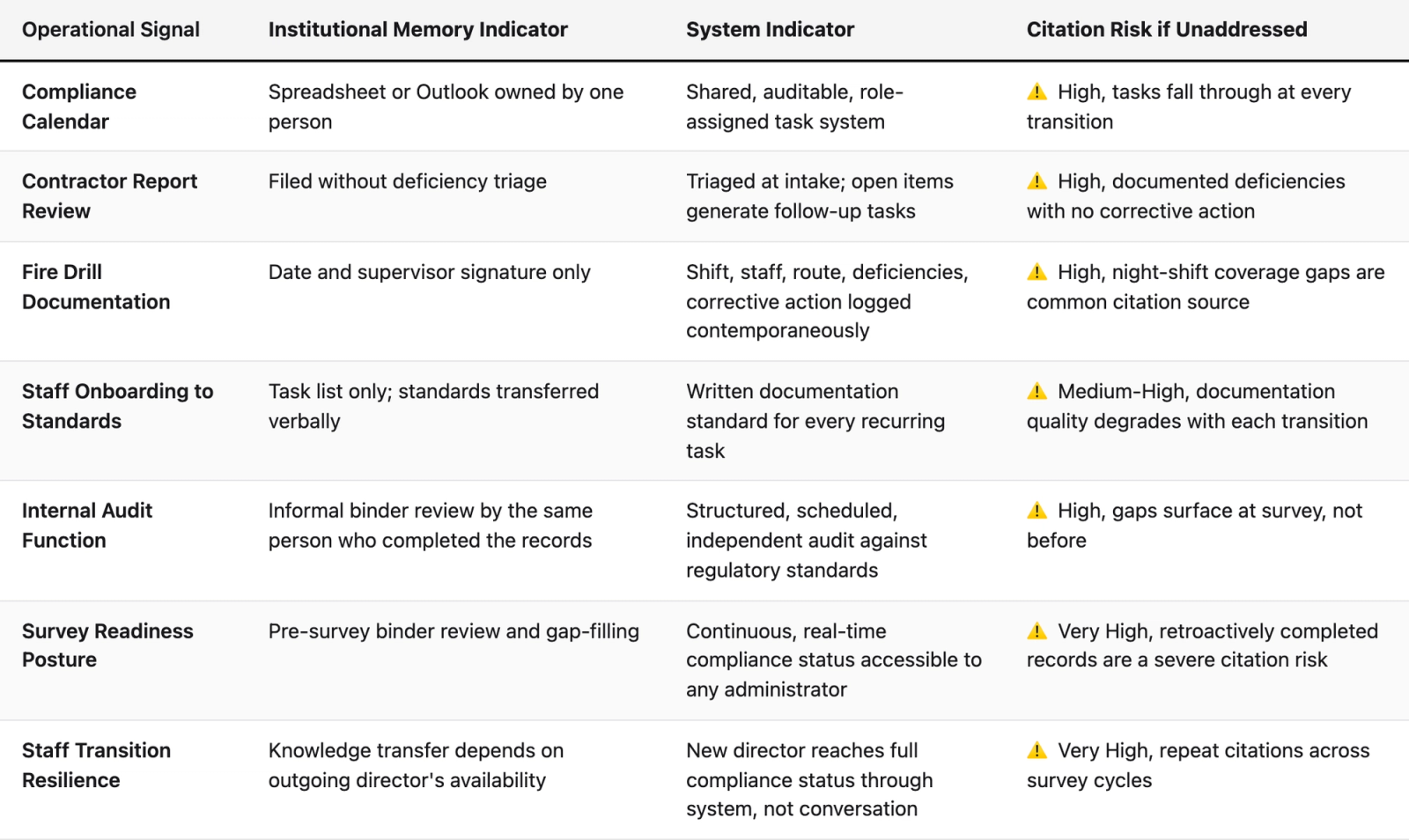
If three or more of these signals describe your current operation, treat that as a strong warning sign that your compliance program's resilience may not support consistent survey performance. The risk is not theoretical. It grows with time: the longer the program runs on institutional memory, the more likely it is that a transition event will expose the gap.
What "Running on System" Actually Requires in a Skilled Nursing Context
The phrase "move from institutional memory to system" is easy to say and genuinely hard to operationalize in an SNF environment. The facilities that do it successfully share a specific set of operational characteristics that distinguish them from facilities that invest in tools without changing the underlying structure.
The Compliance Task Library Must Be Pre-Built, Not Self-Assembled
One of the most persistent failure modes in SNF life safety programs is the attempt to build a compliance task library from scratch. The administrator or maintenance director starts with a blank spreadsheet, adds the tasks they know about, and creates a schedule based on their best understanding of the regulatory requirements. This process produces a library that reflects the builder's knowledge, which means it reflects the same gaps that will produce citations.
A system-based compliance program in an SNF requires a task library that was built by people who know the regulatory standard for each task category: NFPA 101 requirements, NFPA 99 requirements, CMS K-tag expectations, and applicable state survey guidance. That library should specify not just what to do and how often, but what a complete record looks like and what elements a surveyor will check. This is not knowledge that most maintenance directors have comprehensively, and it is not knowledge they should be expected to synthesize from the regulatory text on their own.
Documentation Must Be Contemporaneous by Design
Contemporaneous documentation is not a documentation practice. It is a system design requirement. If the system makes it easier to complete a log entry at the time of the task than to reconstruct it later, contemporaneous documentation happens naturally. If the system requires the maintenance director to return to an office, open a binder, find the correct form, and complete a paper entry after completing the task, retroactive documentation is the path of least resistance.
This is why facility-based documentation systems, whether kiosk-based, mobile, or back-office, need to be physically accessible at the point of task completion. The documentation moment and the task completion moment should be the same moment. When they are separated, the gap between them is where compliance risk accumulates.
The Audit Layer Must Be Automatic, Not Manual
Manual audit, even when conducted by a knowledgeable person, has a fundamental limitation: it finds what the auditor knows to look for. An auditor who has never encountered a K-tag for missing transfer switch operation documentation in a generator test log will not look for it. An auditor who reviews fire drill logs for dates and signatures will not cross-reference them against staffing records. The audit finds the gaps the auditor's experience has taught them to find, which is exactly the institutional memory problem in audit form.
An automatic audit layer, one that cross-references completed records against defined regulatory standards for each task category, finds the gaps that exist in the records regardless of whether anyone knew to look for them. It flags a generator test log missing a kW reading not because the auditor knows that kW readings are required, but because the task template specifies that kW readings are required and the completed record does not contain one. This is the operational difference between a documentation system and a documentation intelligence system.
The Multi-Site Operator's Compounded Risk
Everything described above applies with amplified force to multi-site SNF operators. When a regional facilities manager oversees six to twelve facilities, and each facility's compliance program runs on its own institutional memory, the regional manager's ability to assess compliance status across the portfolio is limited to what each facility's maintenance director chooses to report.
This creates a specific portfolio risk: the facilities where everything appears fine in the regional report are not necessarily the facilities where everything is fine in the documentation. They may be the facilities where the maintenance director is confident and does not escalate concerns, because they do not know what they do not know. The facilities that generate compliance concerns are the ones where the director is less confident, not necessarily the ones with the most significant documentation gaps.
Multi-site operators who have implemented system-based compliance programs often describe a similar discovery: when they gained visibility into facility-level documentation quality through an auditable system rather than through director self-reporting, the compliance risk distribution across their portfolio did not always match their expectations. Some facilities they thought were strong had gaps. Some facilities they thought needed attention had stronger documentation practices than they realized, because the director there was simply more likely to escalate concerns.
For regional and portfolio-level operators, the compliance program resilience question is not just about individual facilities. It is about whether the regional oversight function has access to accurate, current, auditable compliance data, or whether it has access to what each facility's maintenance director believes the compliance status to be. These are not the same thing.
Frequently Asked Questions
What is institutional memory risk in an SNF compliance program?
Institutional memory risk is the compliance exposure that accumulates when a facility's life safety program depends on the knowledge, habits, and experience of specific individuals rather than on documented, system-based processes. When those individuals leave, the program's compliance quality leaves with them, often invisibly, until a survey reveals the gaps they were compensating for.
How does SNF maintenance director turnover affect life safety compliance?
When a maintenance director transitions out, they take with them the compliance calendar, the documentation standards, the contractor relationships, and the institutional knowledge of why specific protocols exist. Without a system that encodes this knowledge independently of any individual, the incoming director inherits a historical record but not the operational intelligence needed to maintain the same compliance quality. This is a major driver of compliance degradation in facilities that experience frequent turnover.
What are K-tags, and why are they the relevant measure of life safety compliance?
K-tags are the CMS citation codes used to document life safety deficiencies found during SNF surveys. They correspond to specific requirements under the Life Safety Code (NFPA 101) and related standards. K-tags are the operational output of life safety compliance failures, and they are the primary regulatory consequence that SNF administrators and compliance programs are managing when they address documentation gaps.
What does "contemporaneous documentation" mean in a life safety context?
Contemporaneous documentation means that the record of a completed task is created at the time the task is completed, not reconstructed afterward from memory. CMS surveyors are trained to identify documentation that appears retroactively completed, and this pattern can result in citations more severe than a missing record, because it indicates a documentation integrity problem rather than an isolated gap.
How can an SNF assess whether its compliance program is system-based or memory-based?
The operational test is straightforward: if the maintenance director were unavailable today, could any administrator or regional manager access a current, complete, auditable compliance status report without making phone calls or searching physical files? If no, the program is memory-based. Additional indicators include whether the compliance calendar requires one person to manage it, whether contractor reports are reviewed for deficiencies at intake, and whether fire drill documentation includes all regulatory-required elements completed contemporaneously.
What are the most common SNF documentation system gaps that surveyors find?
The most frequently cited documentation gaps in SNF life safety surveys cluster around generator test records missing required data elements (particularly kW load readings and transfer switch operation documentation), fire drill logs missing night-shift coverage or lacking required elements, sprinkler system deficiencies without documented corrective action, and emergency lighting test records missing duration data. These are not random gaps. They are the consistent output of documentation practices that complete the task but do not meet the regulatory standard for the record.
Why do facilities receive repeat citations for the same K-tag categories across multiple survey cycles?
Repeat citations typically occur when the corrective action implemented after a citation addresses the specific instance documented by the surveyor rather than the systemic gap that produced it. A citation for a missing generator test record is corrected by completing the record. It recurs when the documentation standard for generator tests was never updated to prevent the same gap from occurring in the next cycle, or when a staff transition resets the compliance knowledge that was temporarily present after the citation.
What is the difference between a compliance audit and a binder review?
A binder review checks for the presence of records. A compliance audit checks whether the records that exist meet the regulatory standard for completeness, timeliness, and required data elements. Most informal internal review processes are binder reviews, not compliance audits. A binder review will find missing records. A compliance audit will find present-but-incomplete records, which are often more dangerous because they give the appearance of compliance while actually documenting non-compliance.
How does survey readiness differ from a pre-survey binder review?
Continuous survey readiness means the documentation is always complete, current, and accessible, so that an unannounced survey finds the same condition as a scheduled review. A pre-survey binder review is an attempt to impose a compliant condition retroactively on documentation that may not have been maintained to standard throughout the survey period. CMS unannounced surveys are designed specifically to prevent pre-survey preparation from substituting for continuous compliance.
What should be included in a life safety task documentation standard?
A documentation standard for any recurring life safety task should specify: the task description, the regulatory basis (NFPA 101/99 section, CMS K-tag category, or state requirement), the required completion frequency, the responsible role, the required data elements for a complete record, the definition of a deficiency finding for that task, and the escalation protocol if a deficiency is identified. If any of these elements is missing, the standard is incomplete and the documentation it produces will be inconsistent.
How should multi-site SNF operators assess compliance program resilience across their portfolio?
Portfolio-level compliance resilience requires that regional managers have access to facility-level compliance data that is auditable and current, not self-reported. This means moving from a model where each facility reports compliance status to the regional manager to a model where the regional manager can directly access documentation quality data for each facility. Facilities that appear compliant in self-reports may have significant documentation gaps that are only visible through direct access to the underlying records.
What is the regulatory basis for requiring specific data elements in generator test documentation?
Generator testing requirements for SNFs come from NFPA 99 Health Care Facilities Code, which references NFPA 110, Standard for Emergency and Standby Power Systems, for the testing frequency, load criteria, and record-keeping requirements for essential electrical systems in healthcare facilities. CMS incorporates these requirements by reference in the Life Safety Code survey process (K-tag K918). Data elements such as kW load readings matter because they show that the generator was exercised under load (for diesel units, at least 30% of nameplate kW or the manufacturer's recommended exhaust temperature), not simply that the engine was started.
Key Takeaways
- Institutional memory risk is not a documentation problem, it is a structural one. The fix is not better documentation practices by the same person. It is building a system that produces compliant documentation regardless of which person is doing the work.
- The seven signals are cumulative. One or two of these patterns may be manageable. Three or more, particularly in combination with recent or anticipated staff transitions, represent a survey readiness exposure that is likely to produce citations.
- Contractor reports with open deficiencies are the most dangerous items in an SNF binder because they document the facility's knowledge of a problem. A missing record is a gap. A filed report with an unresolved deficiency is documented non-compliance.
- Fire drill documentation fails the regulatory standard far more often than it fails the count standard. The drill happened. The record does not prove what the regulation requires it to prove. This distinction is what surveyors check and what informal binder reviews miss.
- Compliance program resilience is measurable. The operational test is whether the program produces the same documentation quality under a five-year director and a five-week director. If the answer is no, the resilience gap is the distance between those two performance levels.
- Internal audit must be independent and structured to find the gaps that matter. An auditor reviewing their own records will find the gaps they know to look for. A structured audit against regulatory standards finds the gaps that exist, regardless of whether anyone knew to look for them.
- Multi-site operators carry compounded risk when portfolio compliance visibility depends on director self-reporting. The facilities that appear most compliant in reports are not necessarily the facilities with the strongest documentation. Direct access to auditable documentation data is the only reliable visibility mechanism.
Building SNF Compliance That Survives the Next Transition
The operational reality of skilled nursing is that staff will turn over. Maintenance directors will retire, relocate, or move to better opportunities. Technicians will leave. The question is not whether the next transition will occur. It is whether your compliance program will survive it at the same quality level it operated at before.
Facilities that consistently perform well across survey cycles share a common characteristic: they have built compliance programs where the regulatory knowledge, the documentation standards, the audit function, and the survey readiness posture are encoded in the system rather than in the people. A new maintenance director at one of these facilities does not have to reconstruct the compliance program. They inherit it, fully functional, with a current task schedule, a complete documentation history, and a visible audit trail that tells them exactly where the program stands.
That is not an aspirational state. It is an operational design choice. And it is the only design choice that produces consistent survey outcomes across the full range of staff transitions, turnover events, and operational disruptions that are the baseline condition of skilled nursing facility management in the United States today.
The seven signals in this article are the diagnostic. The system design described above is the response. The gap between them is the compliance program resilience that every SNF administrator is accountable for, whether they have measured it or not.
About the author
Benjamin Terebelo · Founder
Benjamin is the founder of SEQURA, a compliance platform purpose-built for healthcare facilities. He builds at the intersection of healthcare operations and software, maintaining a focus on bringing modern tooling to systems that the broader industry has largely left behind.
Related reading
About the author
Benjamin Terebelo · Founder
Benjamin is the founder of SEQURA, a compliance platform purpose-built for healthcare facilities. He builds at the intersection of healthcare operations and software, maintaining a focus on bringing modern tooling to systems that the broader industry has largely left behind.
Topics
- SNF compliance institutional memory risk
- life safety program staff turnover
- SNF documentation system gaps
- compliance program resilience SNF
- survey readiness operational signals USA
- SNF maintenance director turnover compliance


