27 min read
9 Compliance Metrics Every SNF Regional Facilities Manager Should Review Weekly — And What Each One Actually Signals
Weekly compliance metrics tell regional SNF managers where documentation risk is building across their portfolio. These 9 indicators are the ones that actually predict citation risk.
By Benjamin Terebelo

Most regional SNF facilities managers are already tracking something. The question is whether what they're tracking is the right thing, at the right cadence, to catch citation risk before a surveyor does. A wall-mounted whiteboard with colored magnets, a shared spreadsheet updated when someone remembers, a binder that leaves the building when the maintenance director does, these are not compliance systems. They are documentation rituals that produce confidence without accuracy.
The gap between "we're tracking compliance" and "we have documented, current, cross-referenced evidence of compliance" is exactly where CMS citations are born. For a regional facilities manager overseeing multiple SNF sites, that gap multiplies with every building added to the portfolio. What looks like a manageable documentation burden at one facility becomes an invisible accumulation of risk at five or ten.
This article is not about which metrics exist. Every life safety consultant can hand you a list of inspection categories. This is about which metrics, reviewed at weekly intervals, actually function as leading indicators of citation risk, and what each one is genuinely signaling about documentation integrity, task discipline, and survey readiness across your portfolio. The nine items below are ordered by the breadth and severity of their downstream risk. If you only had time to look at three, the first three are the ones.
1. Overdue Inspection Task Rate Across the Portfolio
The overdue task rate is the single most predictive metric in a regional SNF facilities manager's toolkit because it is the only one that captures systemic failure before it becomes documented failure. Every other metric in this list is downstream of it. If recurring inspections are not completed on time, every other compliance indicator is compromised at the source.
What this metric actually measures is not whether people are busy. It measures whether your scheduling infrastructure is correctly calibrated to regulatory cadence. NFPA 101 and CMS Appendix PP require inspections, tests, and maintenance (ITM) tasks at specific intervals, daily, weekly, monthly, quarterly, semi-annually, and annually. A facility with a 12% overdue task rate is not simply "behind." It is operating with 12% of its required documentation exposure unresolved, and every week that passes without resolution is a compounding risk to the survey record.
For regional managers, this metric needs to be viewed at both the portfolio level and the individual facility level simultaneously. A portfolio average of 4% overdue can mask one facility sitting at 22% while three others are at 1%. The average is meaningless without the distribution.
What a Rising Overdue Rate Actually Signals
A sudden spike in overdue tasks at a specific facility almost always signals one of three things: a staffing change (the maintenance director or a key technician left or is on leave), a scheduling misconfiguration (a template was modified and new tasks were inadvertently dropped), or a documentation backlog where tasks are being completed but not logged contemporaneously. All three of these produce the same surface reading on a dashboard, but they require completely different interventions.
This is why the overdue rate cannot be managed in isolation. It needs to be cross-referenced with login activity logs and task completion timestamps. If the overdue rate is climbing but completion timestamps are catching up in batches, multiple tasks logged within minutes of each other, that is a contemporaneous documentation problem, not a task completion problem. That distinction matters enormously during a survey, because CMS surveyors are trained to look for exactly that pattern.
How to Apply This Weekly
- Set a portfolio-level alert threshold (a reasonable starting point is anything above 5% for any individual facility).
- Require facility-level managers to provide a written explanation for any facility crossing that threshold within 48 hours.
- Review the task category breakdown, not just the count. Fire and smoke barrier tasks overdue carry higher citation risk than, say, a grounds inspection.
- Track the trend over four weeks, not just the current week. A declining rate from a high point is a recovery signal. A flat rate at a high level is a structural problem.
2. Fire Drill Completion Rate by Shift and Frequency
Fire drill compliance is one of the most common sources of K-tag citations in SNF surveys, and the reason is almost always the same: facilities complete drills, but they complete them unevenly across shifts, and their documentation does not prove shift coverage in the way CMS expects to see it.
NFPA 101 Chapter 18 and 19 requirements for existing and new health care occupancies require fire drills at least quarterly on each shift. That means a minimum of twelve drills annually: four per shift across three shifts. The documentation must clearly show which shift each drill covered, who participated, the date, the time, the drill observer, and the outcome notes. Missing any one of these elements from a single drill record is enough to produce a citation, even if the drill itself actually happened.
For regional facilities managers, the fire drill completion rate needs to be tracked as a compound metric: completion percentage (drills conducted vs. drills required), shift distribution (are all three shifts represented within each quarter), and documentation completeness (are all required fields present in every drill record).
The Common Failure Pattern
The most common failure pattern is not that facilities skip drills. It is that they conduct drills primarily on day shift, because that is when the most staff are available and the administrator is present to observe. Night shift and evening shift drills are harder to schedule, harder to document, and easier to defer. By the time a surveyor arrives, the facility may have completed ten of twelve required drills but all ten were on day shift, and the records show zero night shift coverage for the past two quarters. That is a citation regardless of whether the ten day-shift drills were documented perfectly.
A second common failure is the drill that happened but was not documented until days later. Night shift staff complete a drill at 2:00 AM, intend to log it in the morning, and the log either gets completed late or not at all. The drill is real. The documentation is not.
How to Apply This Weekly
- Track drill completion by facility AND by shift category, not just by total count.
- Flag any facility that is more than 30 days from its next required shift-specific drill without one scheduled.
- Require that drill documentation be completed within 24 hours of the drill, not end of week, not end of month.
- Review documentation completeness fields, not just completion status. A drill logged without an observer name or outcome notes is an incomplete record.
3. Generator Test Documentation Completeness
Emergency generator compliance is a high-visibility area for CMS surveyors, and the documentation requirements are specific enough that partial records are treated the same as missing records. The NFPA 110 Standard for Emergency and Standby Power Systems governs the testing and maintenance of emergency power supply systems, and CMS has incorporated these requirements into the K-tag framework under K915 and related tags.
Monthly load testing requires documentation of runtime, load percentage during the test, transfer time from normal to emergency power, voltage, frequency, and any abnormalities observed. Annual load bank testing at 30% or greater of the nameplate rating requires additional documentation. Many facilities complete the physical test but log only the date and a pass/fail notation. That is not sufficient.
The generator test documentation completeness rate measures the percentage of completed generator test records that contain all required data fields, not just a completion timestamp. This distinction is critical. A facility can show 100% test completion and still have 0% documentation completeness if the records are missing kW load readings, transfer time, or technician signature fields.
What Incomplete Generator Records Signal
Incomplete generator records almost always trace back to one of two root causes. The first is that testing is contracted out to a third-party vendor who provides their own service report, and the facility is filing that report without reconciling it against the required documentation fields. The vendor report may use different terminology or omit fields that CMS specifically requires. The second root cause is that in-house staff are completing the test but using a paper form that was never validated against current regulatory requirements, a form inherited from a predecessor that has not been updated in years.
Both patterns produce the same survey outcome: a technically compliant testing program with a non-compliant documentation record. For a regional manager, this metric surfaces which facilities are relying on unvalidated vendor reports or legacy forms before a surveyor finds them.
How to Apply This Weekly
- Review generator test records not just for completion status but for field-by-field completeness against a current NFPA 110 and CMS-aligned checklist.
- Require that vendor-supplied reports be reconciled with facility documentation templates, do not accept a vendor report as a complete compliance record without cross-referencing required fields.
- Flag any facility where the last generator test record is missing load percentage or transfer time data, as these are the fields most commonly cited.
4. Open Work Order Age for Life Safety Assets
Not all open work orders carry the same risk weight. A broken ceiling tile in a storage room and a sprinkler head with a documented deficiency are both open work orders, but they sit in completely different citation risk categories. The open work order age metric for life safety assets specifically tracks how long deficiencies in fire suppression, egress lighting, fire door hardware, smoke detection, and similar regulated systems remain open without documented resolution or interim protective measures.
CMS surveyors reviewing maintenance records look specifically at whether identified deficiencies were addressed within a reasonable timeframe and whether interim measures (like increased monitoring or an approved equivalency plan) were documented while awaiting repair. An open work order for a fire door that failed its annual inspection and has been sitting unresolved for 90 days is a citation waiting to happen, not just a maintenance backlog item.
For regional facilities managers, this metric needs to segment work orders by asset category, specifically separating life safety assets from general facility maintenance. Tracking "average work order age" across all categories is not useful for compliance purposes. Tracking the maximum age of any open work order touching an NFPA 101 or NFPA 99 regulated asset is the relevant number.
The Interim Measure Documentation Problem
One of the most underappreciated documentation failures in this category is the absence of interim protective measure records. When a life safety deficiency cannot be resolved immediately, because a part is on order, a contractor is unavailable, or a capital approval is pending, CMS expects to see documentation that the facility recognized the deficiency and implemented appropriate interim measures. Increased staff monitoring, removal of the affected asset from service, or a formal equivalency request are all acceptable responses, but they must be documented.
Many facilities have good instincts about interim measures in practice. Staff do increase monitoring. Corridor doors are propped open with approved hold-open devices while hardware is repaired. But the documentation of these measures is frequently absent. The surveyor sees a 60-day-old open work order for a fire door hardware deficiency and no corresponding interim measure record. That is a citation regardless of what actually happened in the facility.
How to Apply This Weekly
- Flag any life safety work order open longer than 30 days for immediate review by the regional manager.
- Require that any life safety work order open longer than 14 days have a documented interim protective measure on file.
- Separate work order aging reports by asset category, do not blend life safety and general maintenance in the same aging bucket.
- Track contractor response commitments as part of the work order record, not separately, so the full timeline is visible in one place.
5. Sprinkler System Inspection and Deficiency Reconciliation Rate
Sprinkler system compliance is one of the most technically complex documentation requirements in SNF life safety management, and it is an area where the gap between "we had the inspection" and "we have compliant documentation" is consistently wide. NFPA 25 Standard for the Inspection, Testing, and Maintenance of Water-Based Fire Protection Systems governs the ITM requirements for sprinkler systems, and CMS cross-references these requirements in multiple K-tags.
The metric that matters here is not whether the inspection happened. It is the deficiency reconciliation rate: of all deficiencies identified during the most recent NFPA 25 inspection, what percentage have been formally closed with documented corrective action, and what percentage remain open? This rate tells a regional manager whether facilities are treating their inspection reports as compliance triggers or as filing obligations.
Many SNFs receive their annual sprinkler inspection report from a contracted fire protection company, file the report, and consider the obligation complete. The inspection report lists deficiencies. The facility does not have a systematic process for tracking those deficiencies to closure. Months later, when a surveyor requests the inspection report and asks about deficiency resolution, the facility has no documented answer.
The Unreconciled Deficiency Citation Pattern
CMS citations related to sprinkler systems frequently involve not the absence of inspections, but the absence of documented corrective action for identified deficiencies. The inspection report itself becomes the evidence of non-compliance, because it identifies a problem and the facility cannot demonstrate resolution. This is a documentation trap that catches facilities that are genuinely trying to maintain their systems but have not built a deficiency-tracking workflow into their compliance process.
For regional facilities managers, the deficiency reconciliation rate surfaces which facilities received inspection reports with open items and have not closed them. A facility with a 60% reconciliation rate has 40% of its identified sprinkler deficiencies sitting unresolved in the record, a significant citation risk that is completely invisible if the only metric being tracked is "did the inspection happen."
How to Apply This Weekly
- Require that every sprinkler inspection report received from a contractor be entered into the compliance system as a deficiency log, not just filed as a document.
- Track deficiency reconciliation rate separately from inspection completion rate, they measure different things.
- Flag any facility where the reconciliation rate drops below 80% for immediate follow-up.
- Require documented evidence of corrective action (contractor invoice, repair record, or re-inspection note) for every identified deficiency before it is marked closed.
6. Documentation Contemporaneity Score
Contemporaneous documentation is one of the most important and least discussed concepts in SNF compliance management. A record that says an inspection was completed is only credible if the timestamp on the record is consistent with when the inspection actually happened. CMS surveyors are trained to identify retroactive documentation patterns, records completed hours, days, or weeks after the fact, and these patterns are treated as documentation integrity failures, not just administrative oversights.
The documentation contemporaneity score measures the percentage of completed inspection records where the log timestamp falls within a defined window of the scheduled task time. A reasonable threshold for most recurring inspection tasks is within 2 hours of completion. Tasks logged more than 4 hours after their scheduled window warrant review. Tasks logged the following day or later are a documentation integrity concern.
This metric is particularly important for regional facilities managers because it is invisible in paper-based or simple spreadsheet systems. When everything is logged manually, there is no way to distinguish a record completed at the time of inspection from one completed the following morning. Digital systems with server-side timestamps create an auditable record of when documentation actually occurred. That record can protect a facility in a survey, or expose it.
Why Batch Logging Is a High-Risk Pattern
The most common contemporaneity failure is batch logging: a maintenance director or technician completes multiple inspections throughout the day but logs all of them at the end of a shift or the end of a week. The records are accurate in their content, the inspections happened, but the timestamps tell a story that looks like retroactive documentation to a surveyor. Multiple tasks logged within a 10-minute window, covering inspections that were scheduled across three different days, is a red flag that experienced surveyors recognize immediately.
Batch logging typically reflects a workflow problem, not a dishonesty problem. Staff are focused on completing the physical work and treat documentation as a secondary task. The solution is structural: require documentation at the point of task completion, using a facility kiosk or mobile device that generates a contemporaneous timestamp at the moment of submission. This removes the batch-logging temptation and creates a defensible audit trail.
How to Apply This Weekly
- Review timestamp distributions for completed tasks, specifically look for clusters of completions logged within short windows that span multiple scheduled days.
- Flag any facility where more than 10% of weekly task completions are logged more than 4 hours after their scheduled time.
- Identify whether the pattern is individual (specific staff member) or systemic (entire facility logging at end of week) and respond accordingly.
- Consider requiring point-of-task documentation via kiosk or mobile for all recurring life safety inspections, this is the structural fix for contemporaneity problems.
7. K-Tag Coverage Completeness by Facility
K-tags are the CMS Life Safety Code citation categories used during surveys of SNFs and other healthcare facilities. There are over 300 K-tags organized across major Life Safety Code chapters, but the tags that appear most frequently in SNF citations cluster around a more manageable set of categories: fire alarm systems, sprinkler systems, smoke compartments, egress, fire drills, and emergency power. Knowing which K-tags are covered by current documentation, and which are not, is the foundation of survey readiness.
The K-tag coverage completeness metric measures the percentage of applicable K-tags for which the facility currently has documentation that would satisfy a surveyor's request. This is not the same as "have we done the inspections." It is a documentation audit question: if a surveyor requested evidence for K-tag 341 (emergency lighting testing) right now, would the facility be able to produce a complete, current, dated record? If not, that K-tag is uncovered, regardless of whether the physical testing has been performed.
For regional facilities managers, this metric enables portfolio-level K-tag risk mapping. Instead of asking "are our facilities compliant," the question becomes "which K-tags are uncovered at which facilities, and how many of those uncovered tags are in the high-citation-frequency categories?" That is a risk stratification framework, not just a compliance checklist.
Building a K-Tag Risk Map for Your Portfolio
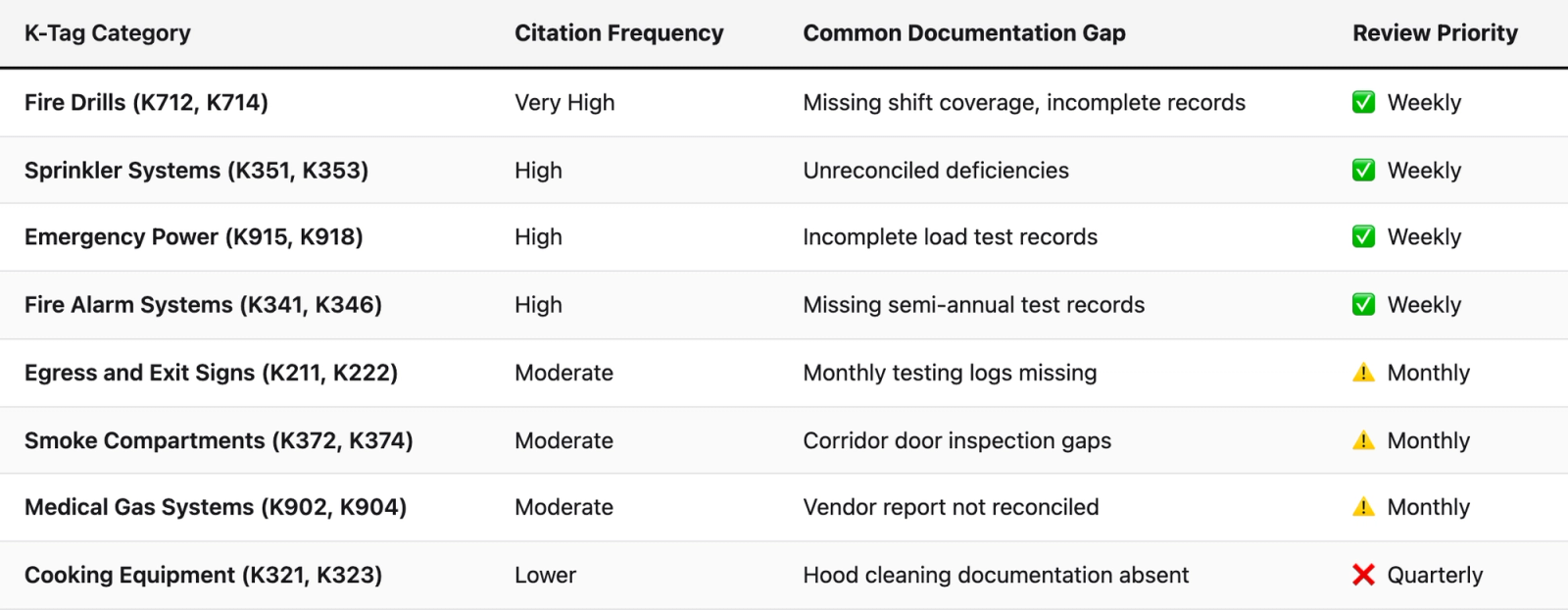
Use this framework to prioritize which K-tag coverage gaps require immediate attention versus which can be addressed in a scheduled review cycle. The high-citation-frequency tags should have weekly coverage verification in the regional manager's dashboard.
8. Contractor Documentation Receipt Rate
A substantial portion of required life safety inspections in SNFs are performed by licensed third-party contractors rather than in-house staff: sprinkler inspections, fire alarm testing, generator servicing, elevator inspections, kitchen hood cleaning, medical gas certifications, and others. The compliance documentation for these inspections lives in the contractor's service report. When that report is not received, not filed, or not reconciled against facility records, the inspection effectively did not happen from a documentation standpoint.
The contractor documentation receipt rate measures the percentage of contractor-performed inspections, within a defined review period, for which the facility has received, logged, and filed a complete service report. This metric is deceptively simple in concept and surprisingly difficult to manage in practice, because it requires tracking an external dependency: the contractor's timeliness and completeness in producing their documentation.
Many SNFs discover during survey preparation that they have no record of a required inspection, not because the inspection was skipped, but because the contractor performed the work, sent the invoice, and never sent the service report, or sent it to an email address that no longer exists, or sent it to the administrator who filed it in a drawer rather than the compliance system. The inspection happened. The documentation did not arrive.
The Contractor Documentation Accountability Gap
Regional facilities managers frequently underestimate the documentation accountability gap with contractors because the relationship is framed around service delivery, not documentation delivery. A contractor who reliably shows up and performs quality work earns trust. That trust extends, often incorrectly, to an assumption that their documentation is equally reliable. In practice, service quality and documentation quality are independent variables. A technically excellent fire alarm testing company may routinely produce reports that arrive weeks after the inspection, omit required fields, or use terminology that does not map cleanly to CMS K-tag categories.
The solution is to treat contractor documentation as a facility responsibility, not a contractor courtesy. This means establishing explicit documentation delivery requirements in service contracts: the facility expects a complete service report within a defined number of business days of service completion, in a format that includes specific required fields. It also means having a tracking system that flags when an expected contractor report has not been received, a follow-up trigger, not a passive waiting posture.
How to Apply This Weekly
- Maintain a contractor service schedule that shows expected report receipt dates for every upcoming and recent inspection, not just service dates.
- Flag any contractor report not received within 5 business days of the service date for follow-up.
- Review received reports for completeness before filing, do not treat receipt as equivalent to compliance.
- Track contractor documentation receipt rates by vendor over time. A vendor with a persistent documentation delivery problem is a compliance liability that warrants a contract conversation or vendor change.
9. Survey Readiness Self-Assessment Score Trend
Survey readiness is not a binary state. A facility is not either "ready" or "not ready" for a CMS survey. It exists on a continuum, and the position on that continuum shifts weekly based on the status of every other metric in this list. The survey readiness self-assessment score is a composite indicator that aggregates the signals from the preceding eight metrics into a single facility-level and portfolio-level number, and more importantly, tracks the trend of that number over time.
A single-point-in-time score is less useful than a trend. A facility scoring 72% on a survey readiness composite that was at 58% four weeks ago is improving rapidly. A facility scoring 74% that was at 88% four weeks ago is deteriorating and needs immediate attention. The trend reveals operational trajectory. The point-in-time score reveals current state. Both matter for a regional manager trying to allocate attention across multiple facilities.
The self-assessment score should be structured to weight components by citation risk, not by documentation volume. Fire drill coverage and generator test completeness should carry more weight than grounds maintenance records, because the citation risk is asymmetric. A composite score that treats all documentation categories equally will produce a number that looks healthy when the high-risk categories are actually exposed.
Building a Weighted Survey Readiness Score
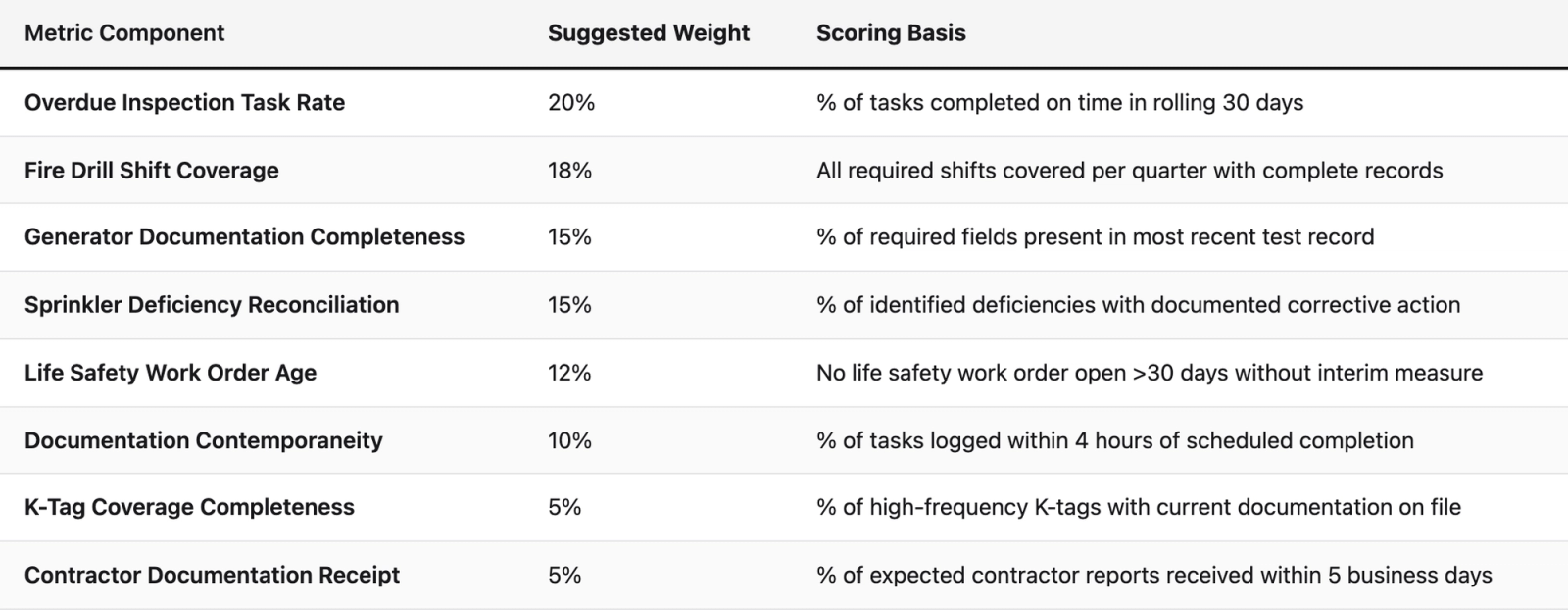
This weighting model reflects citation frequency and documentation complexity, not just task volume. It gives regional managers a single number that actually correlates with survey risk, rather than a composite that can be inflated by high completion rates in low-risk categories.
How to Apply This Weekly
- Review the composite score trend for each facility over the most recent four-week rolling window.
- Flag any facility showing a declining trend across two or more consecutive weeks, regardless of the absolute score.
- Use the component breakdown to identify which specific metric is driving a decline, do not treat the composite score as a final answer.
- Set a portfolio-level minimum acceptable score (a reasonable starting threshold is 80%) and require facilities below that threshold to submit a remediation plan within 72 hours.
How to Structure a Weekly Regional Review Around These Nine Metrics
Having the right metrics is necessary but not sufficient. The review process itself needs to be structured to convert metric signals into action within the same week. A regional facilities manager reviewing metrics on Friday afternoon for problems that surfaced Monday is five days behind. The operational goal is same-week identification and same-week escalation for any metric that crosses a defined threshold.
A practical weekly review structure for a regional SNF facilities manager overseeing five to fifteen facilities should follow this sequence:
- Portfolio-level dashboard scan (15 minutes): Review all nine metrics at the portfolio level to identify any that are outside normal range. This is a triage step, not a deep dive. The goal is to identify which facilities need individual attention this week.
- Facility-level drill-down for flagged sites (30-60 minutes): For any facility that triggered a threshold alert, review the underlying data to determine the root cause category: staffing, scheduling, workflow, or contractor. This determines the response type.
- Escalation and action assignment (15 minutes): Assign specific corrective actions to specific people with specific due dates before the end of the review session. Metrics that are reviewed but not acted upon within the same week do not improve compliance, they improve the appearance of oversight.
- Trend review for stable facilities (15 minutes): Even facilities that are within threshold should be reviewed for trend direction. A facility at 88% that has declined from 94% over three weeks needs a conversation before it crosses the threshold, not after.
The entire review, structured this way, should require no more than two hours per week for a portfolio of ten facilities. If it is taking longer, the metric presentation layer needs to be simplified, the goal is rapid signal identification, not documentation of the review itself.
The Difference Between a Compliance Dashboard and a Compliance System
Many multi-site SNF operators have compliance dashboards. Fewer have compliance systems. The difference is consequential. A dashboard shows you what the current state is. A system generates the data that populates the dashboard, validates that the data is complete and contemporaneous, surfaces the gaps the data reveals, and routes those gaps to the people who can close them. A dashboard without a system behind it is a visualization of whatever data someone remembered to enter, which is not the same as a visualization of actual compliance state.
For regional facilities managers, this distinction matters because it determines whether the metrics they are reviewing are trustworthy signals or optimistic estimates. Metrics generated by a system with contemporaneous logging, field-level completeness validation, and automated gap detection are actionable. Metrics generated by a system that depends on manual entry and self-reporting are approximations, useful approximations, but not the same thing as a defensible audit trail.
The nine metrics in this article are only as reliable as the documentation infrastructure generating them. A platform like SEQURA, built specifically for SNF life safety compliance, is designed to address this infrastructure problem: ensuring that the data feeding the metrics is captured at the point of task completion, validated against regulatory requirements, and auditable in the format a surveyor would actually review. That is the operational foundation that makes weekly metric review genuinely predictive rather than retrospectively reassuring.
Common Regional Manager Mistakes When Reviewing These Metrics
Even experienced regional facilities managers fall into patterns that reduce the effectiveness of their weekly metric review. These are the most common, and they are worth naming explicitly because they are not obvious from inside the process.
Reviewing Averages Instead of Distributions
Portfolio averages mask facility-level problems. A 4% average overdue task rate across ten facilities tells you almost nothing about which facilities are at risk. If one facility is at 28% and nine are at 1%, the average is 3.7% and looks fine. The facility at 28% is not fine. Always review the distribution alongside the average, and set individual facility thresholds, not just portfolio-level thresholds.
Treating Completion as Equivalent to Compliance
Task completion rates measure whether someone logged a task as done. They do not measure whether the documentation would withstand a surveyor's review. Completion rate and documentation quality are different metrics. A facility can have a 98% completion rate and still have significant citation risk if the completed records are missing required fields, are logged retroactively, or are attached to the wrong asset.
Focusing on Volume Instead of Pattern
A facility that completed 200 inspections this week and a facility that completed 20 inspections this week may have identical compliance risk profiles if the 200-inspection facility has a contemporaneity problem and the 20-inspection facility has clean, complete, timely records. Volume is not a proxy for quality. The pattern of how documentation is being generated matters more than how much of it exists.
Deferring Contractor Documentation Follow-Up
Contractor documentation gaps are easy to defer because they involve an external party and require a different kind of follow-up than internal task management. This is exactly why they are so frequently unresolved at survey time. Build contractor documentation receipt tracking into the same weekly review cycle as internal task metrics, and assign a specific person at each facility who is responsible for following up on overdue contractor reports within 5 business days.
Frequently Asked Questions
What is the most commonly cited life safety deficiency in SNF surveys?
Fire drill documentation deficiencies consistently appear among the most frequently cited life safety findings in SNF surveys. Specifically, incomplete records, missing shift coverage, and inadequate observer documentation are the primary citation drivers. The CMS Nursing Home guidance page provides the regulatory framework, but the documentation specifics are governed by NFPA 101 Chapter 18 and 19 requirements.
How often should a regional SNF facilities manager review compliance metrics?
Weekly review is the minimum effective cadence for the nine metrics described in this article. Daily monitoring of overdue task rates is advisable for facilities that are actively recovering from a prior survey finding or approaching a known survey window. Monthly or quarterly review of compliance metrics is too infrequent to identify and resolve documentation gaps before they compound into citation risk.
What is a K-tag in the context of SNF compliance?
K-tags are the citation codes used by CMS surveyors to document Life Safety Code deficiencies found during SNF surveys. Each K-tag corresponds to a specific provision of NFPA 101 (Life Safety Code) or NFPA 99 (Health Care Facilities Code). Common K-tags include K712 (fire drills), K915 (emergency generator testing), and K351 (sprinkler systems). Understanding which K-tags are most frequently cited in your state is essential for prioritizing documentation review.
How does contemporaneous documentation differ from retroactive documentation?
Contemporaneous documentation is recorded at or near the time of the inspection or task completion. Retroactive documentation is recorded significantly after the fact. CMS surveyors are trained to identify retroactive documentation through timestamp analysis and can treat it as a documentation integrity concern even if the underlying inspection actually occurred. The practical standard is that documentation should be completed within the same shift as the task, at minimum.
What should a regional facilities manager do when a facility has a high overdue task rate?
First, determine the root cause: staffing change, scheduling misconfiguration, or documentation backlog. Each requires a different response. A staffing gap requires interim coverage and task reassignment. A scheduling misconfiguration requires template review and correction. A documentation backlog requires a workflow intervention to move logging to the point of task completion rather than end-of-shift or end-of-week. Do not simply reset overdue tasks without understanding why they became overdue.
Are contractor inspection reports sufficient for CMS compliance documentation?
Contractor reports are necessary but not always sufficient on their own. CMS surveyors may require that contractor reports be reconciled with facility-maintained logs, that identified deficiencies have corresponding corrective action documentation, and that reports reference the specific regulatory standards the inspection addressed. Treat contractor reports as source documents that need to be integrated into the facility's compliance record, not as standalone compliance evidence.
How should a SNF handle a life safety deficiency that cannot be immediately corrected?
When a life safety deficiency cannot be immediately corrected, the facility must document the deficiency, implement appropriate interim protective measures (such as increased monitoring, removal from service, or enhanced staff awareness), and establish a documented remediation timeline. The interim measure documentation is as important as the deficiency identification itself. Facilities that identify deficiencies but have no documented interim response are in a weaker survey position than facilities that document both the problem and their response to it.
What is the difference between a life safety dashboard and a life safety compliance system?
A dashboard visualizes data. A compliance system generates, validates, and organizes the data that a dashboard displays. A dashboard without a compliant underlying system is only as accurate as the data entered into it. A true compliance system captures documentation at the point of task completion with contemporaneous timestamps, validates records against regulatory field requirements, and surfaces gaps automatically rather than waiting for manual review. The metrics reviewed on a dashboard are only trustworthy if the system generating them is built to regulatory standards.
How do state-specific survey requirements affect the metrics a regional manager should track?
State survey agencies operate under CMS federal requirements but may have additional state-specific life safety standards that create supplemental documentation obligations. Some states require additional fire drill elements, stricter generator testing documentation, or state-specific inspection cadences that exceed federal minimums. Regional facilities managers overseeing facilities in multiple states need to ensure their compliance templates reflect state-specific requirements, not just federal CMS standards, because state surveyors can cite facilities for failing to meet state requirements even when federal documentation is complete.
How does staff turnover affect SNF life safety compliance documentation?
Staff turnover, particularly in the maintenance director role, is one of the most common triggers for documentation gaps in SNF facilities. When a maintenance director leaves, the institutional knowledge about where records are stored, which contractors are responsible for which inspections, and which tasks are in progress often leaves with them. The mitigation is documentation infrastructure that is system-based rather than person-based: inspection schedules, contractor contacts, task assignments, and compliance records that live in a platform accessible to any authorized user, not in a physical binder tied to a specific individual.
What is the relationship between maintenance KPIs in healthcare and survey outcomes?
Maintenance KPIs in healthcare, including task completion rates, work order aging, and preventive maintenance adherence, are leading indicators of survey outcomes when they are structured to reflect regulatory requirements rather than general facility management standards. A generic facilities management KPI framework may optimize for cost efficiency or asset longevity. A healthcare-specific maintenance KPI framework must also optimize for documentation completeness, regulatory cadence alignment, and audit trail integrity. The two frameworks overlap but are not identical, and facilities that import generic maintenance KPIs without adapting them to healthcare regulatory requirements often find gaps in their survey readiness.
How many facilities can a single regional SNF facilities manager effectively oversee with these metrics?
The effective span of oversight depends heavily on the quality of the compliance infrastructure at each facility. A regional manager relying on manual reporting from facility-level staff can realistically provide meaningful oversight to five to eight facilities before the information lag and review burden become unmanageable. A regional manager with a centralized compliance platform providing real-time metric visibility, automated alerts, and standardized reporting can extend effective oversight to fifteen or more facilities with the same weekly review time investment. The constraint is not the manager's capacity, it is the system's ability to surface the right signals without requiring manual aggregation.
Key Takeaways
- The overdue inspection task rate is the master metric, every other compliance indicator is downstream of whether recurring inspections are being completed on time and documented contemporaneously.
- Completion rate and documentation quality are not the same thing. A high task completion rate with poor contemporaneity, missing fields, or unreconciled deficiencies still produces citation risk.
- Fire drill shift coverage is one of the most commonly cited deficiencies in SNF surveys, and it is almost always a documentation problem rather than a drill completion problem. Track shift distribution, not just total count.
- Generator test records must include specific data fields (load percentage, transfer time, voltage, frequency) to be compliant. A completion timestamp without these fields is an incomplete record from a CMS perspective.
- Contractor documentation receipt rate is an external dependency that must be actively managed. Receipt of a service report is not the same as a complete, compliant documentation record.
- K-tag coverage completeness provides a regulatory-aligned view of survey readiness that generic task completion metrics do not. Mapping documentation gaps to specific K-tags reveals the citation risk profile of each facility.
- A weighted survey readiness composite score that reflects citation frequency, rather than documentation volume, gives regional managers a single number that actually correlates with survey risk.
- Portfolio averages mask facility-level risk. Always review metric distributions alongside portfolio averages, and set individual facility thresholds that trigger escalation regardless of the portfolio mean.
- The metrics in this list are only as reliable as the documentation infrastructure generating them. Life safety compliance data captured through a platform with contemporaneous logging and field-level validation is fundamentally more defensible than data entered manually and reviewed retrospectively.
About the author
Benjamin Terebelo · Founder
Benjamin is the founder of SEQURA, a compliance platform purpose-built for healthcare facilities. He builds at the intersection of healthcare operations and software, maintaining a focus on bringing modern tooling to systems that the broader industry has largely left behind.
Topics
- SNF regional facilities manager metrics
- compliance KPIs for SNF
- life safety dashboard metrics
- maintenance KPIs healthcare
- survey readiness indicators


