25 min read
The Compliance Accountability Gap: Why SNF Nursing and Plant Ops Teams Document the Same Environment of Care Tasks Differently — And What That Costs You
When nursing and plant ops document the same environment of care tasks independently, gaps appear. Learn how that misalignment produces K-tag citations at survey.
By Benjamin Terebelo

Picture two employees walking the same corridor on the same Tuesday morning. The charge nurse notices the smoke detector housing has a hairline crack and jots it down in the nursing station's environment of care log. Twenty minutes later, the maintenance technician walks the same hallway during his weekly rounds, sees the detector housing, and notes it differently, or not at all, in the plant ops binder sitting on the director's desk. By Thursday, the crack is repaired. By the following month, both logs have moved on. By the time a CMS surveyor arrives for an unannounced life safety inspection, neither record tells a coherent story. The nursing log shows an observation with no corrective action trail. The plant ops log shows a repair with no triggering observation. The surveyor sees two incomplete documentation chains covering the same asset and the same timeframe. That is the compliance accountability gap, and it is one of the most consistently overlooked sources of K-tag citations in skilled nursing facilities today.
This article explains how that gap forms, why it persists across departments that are genuinely trying to do their jobs, what it costs in citation risk, and how facilities that close it operationally tend to perform differently at survey.
What the Compliance Accountability Gap Actually Is
The compliance accountability gap is not a failure of effort. It is a structural failure of documentation design. In most skilled nursing facilities, nursing staff and plant operations staff share responsibility for the physical environment, but they track that shared environment through separate, disconnected systems. The gap is the space between what each department recorded and what a complete, defensible compliance record actually requires.
To understand why this happens, it helps to think about how environment of care accountability is distributed in a typical SNF. Nursing staff are responsible for patient safety observations: corridor obstructions, functioning call systems, the condition of equipment near patients, hazard reporting. Plant operations staff are responsible for scheduled inspections, corrective maintenance, and the NFPA-compliant documentation that CMS life safety surveyors review. Both departments interact with the same physical spaces. Neither department's records, on their own, tell the full story.
The gap appears in at least three distinct forms:
- Observation without resolution: Nursing documents a hazard. Plant ops fixes it. No cross-reference exists. The surveyor sees an open hazard note with no documented closure.
- Resolution without observation: Plant ops repairs or inspects an item. No nursing-side observation or work order request exists in the record. The repair looks reactive but the trigger is missing, which raises questions about whether the item was operating correctly beforehand.
- Parallel documentation of the same task at different intervals: Both departments are checking something, say, fire door self-closing function, but at different frequencies, with different terminology, in formats that cannot be reconciled at survey. The surveyor finds two sets of records that should agree but don't.
Each of these forms creates a documentation chain that a surveyor can reasonably question. The question is not always about whether the work was done. It is often about whether the facility can demonstrate, through contemporaneous documentation, that the work was done correctly, by the right person, at the right time, with the right result recorded. When nursing and plant ops are logging independently without a reconciliation mechanism, that demonstration becomes difficult or impossible to construct after the fact.
Why the Gap Is Built Into Most SNF Operations
The interdepartmental documentation split is not accidental. It reflects the way federal and state regulations assign responsibility, the way most SNFs were operationally designed before life safety survey pressure intensified, and the way paper-based documentation systems naturally evolve when two departments have different reporting structures.
CMS life safety surveys evaluate compliance with the Life Safety Code published by the National Fire Protection Association, as adopted and interpreted through CMS survey protocols. The survey process assigns K-tags to specific regulatory requirements, and those requirements cut across departmental lines in ways that most SNF org charts were never designed to accommodate. A fire drill, for instance, requires that staff know and execute evacuation procedures. That is a nursing function. It also requires that the drill be documented to a specific standard, including shift, date, scenario, staff participation, and critique. That documentation function typically falls to plant ops or the administrator. When the drill happens and both sides document it independently, the records sometimes conflict, different participant counts, different scenario descriptions, different times logged.
The deeper structural problem is that most SNFs do not have a single owner of environment of care documentation. Nursing leadership owns clinical documentation. Maintenance leadership owns plant documentation. The environment of care sits between them, and the documentation of that environment inherits both systems. There is no natural forcing function that requires the two systems to agree.
Paper binders make this worse. The nursing station's environment of care log and the maintenance director's NFPA binder are physically separate objects, stored in different rooms, reviewed by different people on different schedules. They may never be compared against each other until a surveyor asks to see both simultaneously. By that point, the gaps are visible to the surveyor before they are visible to the facility.
How Surveyors Find the Gap During a Life Safety Survey
CMS life safety surveyors are trained to review documentation alongside physical observation. They do not simply accept a completed log as proof of compliance. They cross-reference what the log says with what they observe in the facility, and they look for consistency between record types. When nursing and plant ops documentation are misaligned, surveyors often find the gap before facility leadership does.
The standard survey process for a skilled nursing facility includes a review of life safety documentation as part of the Life Safety Survey conducted using the CMS Life Safety Code survey protocols. Surveyors request specific documentation categories, including fire drill records, inspection logs for fire protection systems, generator maintenance records, and hazardous area documentation. They review these records alongside their physical walkthrough of the facility.
When they request fire drill records and the nursing log shows a different participant count than the plant ops record for the same drill, that discrepancy creates a citation opportunity. When they request inspection records for corridor fire doors and find that nursing has documented self-closing function observations on a monthly basis while plant ops has no corresponding annual inspection record, the incomplete documentation chain is visible. When they find hazard observation notes in a nursing log without a corrective action record in the maintenance system, they have documented evidence of a potentially unresolved life safety concern.
None of these situations require the surveyor to prove bad intent. They simply require the surveyor to note that the documentation does not demonstrate compliance. The burden of proof in CMS life safety surveys sits with the facility: the facility must be able to show through its records that required inspections and activities occurred. When the records are fragmented across departments and cannot be reconciled, that demonstration fails.
There is an additional dynamic worth understanding. Surveyors review records over a period of time, and they are looking for patterns as much as individual gaps. A single missing entry in a fire drill log might be explained away. A pattern of misaligned documentation across multiple categories, across multiple months, signals a systemic documentation problem. Systemic problems are evaluated differently than isolated deficiencies under CMS scope and severity guidelines, which means the gap between nursing and plant ops records is not just a citation risk for individual items. It is a scope risk for the overall survey outcome.
The K-Tag Categories Where the Gap Shows Up Most Often
Not every life safety requirement carries equal interdepartmental risk. Some tasks are clearly owned by plant operations and require no nursing involvement. Others sit squarely in the shared documentation space where the gap tends to appear. Understanding which categories create the most interdepartmental friction helps facilities prioritize their documentation design.
The table below organizes common life safety documentation categories by the degree of interdepartmental accountability they require. This is not a comprehensive K-tag list; it is a framework for understanding where shared documentation creates the most risk.
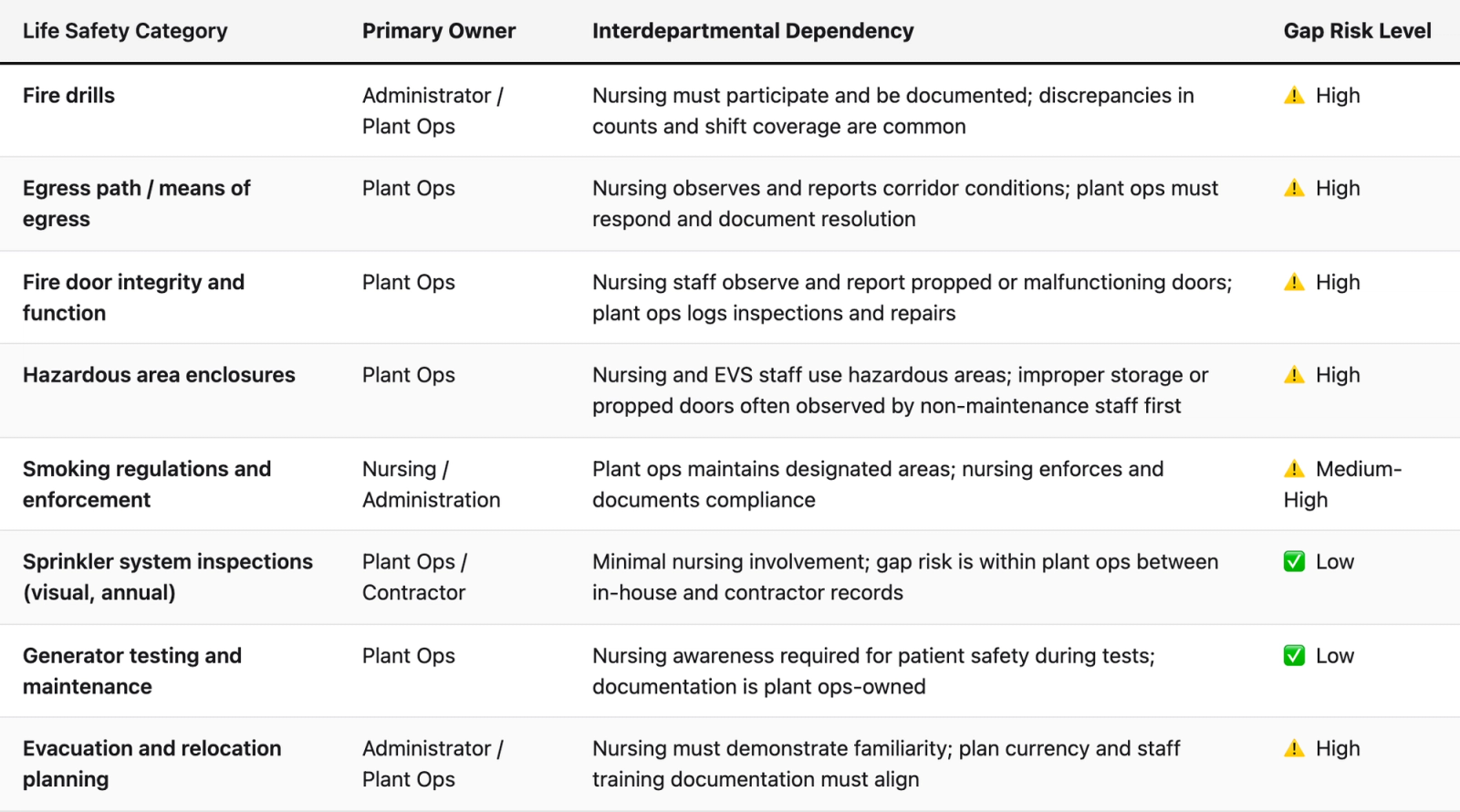
The categories with high interdepartmental dependency are the ones where facilities most consistently encounter the documentation gap. They are also, not coincidentally, the categories where surveyors spend the most interview and record-review time during life safety surveys. A surveyor who asks a charge nurse to describe the most recent fire drill and then compares that account with the written drill record is specifically testing for the gap.
Fire Drills: The Most Visible Expression of the Accountability Gap
Fire drills deserve their own section because they are the single environment of care task most likely to expose the nursing-plant ops documentation gap. Under the Life Safety Code as adopted by CMS, skilled nursing facilities are required to conduct fire drills across all shifts, including overnight, with documentation that supports the facility's ability to demonstrate consistent and complete participation. The CMS life safety requirements for long-term care are specific about what that documentation must demonstrate.
The documentation problem with fire drills is that the activity is inherently multi-departmental but the record is almost always single-department. In most SNFs, the plant operations director or administrator prepares and retains the fire drill record. That record includes the date, time, shift, number of staff participating, the scenario used, and any critique notes. What it frequently does not include is a reconciled account of which nursing staff participated, how nursing leadership confirmed participation, or how the drill was communicated across departments before and after it occurred.
When a surveyor interviews nursing staff about fire drills, they are looking for alignment between what the record says and what the staff knows. If the drill record says 22 staff participated on the 11 PM to 7 AM shift but the charge nurse on duty that night cannot recall the drill, or recalls it differently, or was not listed in the record, the surveyor has found a documentation gap that calls the entire record into question.
There is also a shift coverage dimension that catches many facilities off guard. The requirement for overnight and weekend drill coverage means that the staff who need to be documented are the staff least likely to be supervised by the people who typically manage documentation. The maintenance director who runs drills during the day shift may have no direct visibility into how the 3 AM drill was conducted, documented, and cross-referenced. If nursing leadership on that shift creates a separate log entry and plant ops creates another, and the two are never reconciled, the gap is already present by sunrise.
Creating and retaining drill records that were not produced contemporaneously is a serious documentation concern. While CMS does not treat every after-the-fact correction as falsification, records that were clearly assembled after the fact, without contemporaneous documentation, raise significant credibility questions during survey review. The practical implication is that facilities cannot reconstruct their way out of a fire drill documentation gap at survey time. The record either exists in a form that demonstrates contemporaneous, cross-referenced documentation, or it does not.
Hazardous Areas and Egress: Where Nursing Observations Drive Plant Ops Accountability
Hazardous area enclosures and means of egress represent a category where nursing staff are often the first to observe a compliance problem and plant operations staff are responsible for fixing and documenting it. The gap forms in the handoff between observation and resolution.
In a functioning SNF, a nursing aide who notices that the door to a soiled linen room is propped open should report that observation through some mechanism that reaches plant operations. Plant ops should respond, confirm or restore proper door function, and document the action. The nursing observation and the plant ops response should exist in the same retrievable record, or at minimum in two records that can be cross-referenced.
In the typical SNF operating on paper binders and verbal handoffs, none of that happens systematically. The aide mentions it to the charge nurse. The charge nurse may or may not document it. The maintenance technician may or may not receive a work order. The door may be fixed the same day by whoever notices it is propped. Three weeks later, the nursing log has a note about a propped door. The plant ops log has no corresponding entry. The surveyor reviewing both logs sees an unresolved observation, even though the problem was fixed the same day it was noticed.
The same dynamic applies to egress path obstructions. The requirement that means of egress be kept clear is one of the more practically observable life safety requirements. Surveyors walk the egress paths during their physical tour and compare what they see with what the facility's documentation shows. When nursing staff have documented observations of corridor obstructions, equipment staged in hallways, carts left overnight, stored materials blocking exit access, and no corresponding plant ops resolution exists in the record, the surveyor has a documentation gap that may also be corroborated by what they observe during the walkthrough.
The pattern is consistent: nursing observes, plant ops resolves, but no documentation links the two. The result is a compliance record that is incomplete by design, not by negligence. The facility did the right thing operationally. It simply did not build the documentation infrastructure to demonstrate that it did.
The Cost of the Gap: Citations, Scope, and the Survey Outcome
Understanding what the documentation gap costs requires understanding how CMS life safety citations are evaluated and what determines their impact on a facility's regulatory standing.
CMS evaluates life safety deficiencies using a scope and severity grid that assesses both the breadth of the problem (isolated, pattern, or widespread) and its severity (potential for harm, actual harm, or immediate jeopardy). The scope dimension is where interdepartmental documentation gaps become particularly costly. A single missing fire drill record might be evaluated as an isolated deficiency. A pattern of misaligned nursing and plant ops documentation across fire drills, egress observations, and hazardous area records signals a systemic documentation problem, and systemic problems are more likely to be evaluated at the pattern or widespread scope level.
It is important to note that scope and severity determinations involve surveyor judgment and are not the product of a mechanical formula. The scope and severity grid structures that judgment, but outcomes vary based on what the surveyor observes, what the facility can demonstrate, and how the overall survey picture develops. That said, facilities with fragmented interdepartmental records are giving surveyors more material to work with, and more material generally means more risk of unfavorable scope determinations.
Life safety citations also carry enforcement implications that extend beyond the survey itself. CMS enforcement remedies for life safety deficiencies range from directed plans of correction to civil monetary penalties and, in serious cases, denial of payment for new admissions. The CMS enforcement remedies framework ties the severity of remedies to the scope and severity of deficiencies found. A pattern-level finding in a high-severity category carries significantly different enforcement exposure than an isolated low-severity citation.
There is also a reputational dimension. Life safety inspection results are posted publicly through Medicare's Care Compare website. While life safety deficiencies are displayed separately from the health inspection data used in Five-Star Quality Rating calculations, they are visible to families, referral sources, and hospital discharge planners evaluating facility quality. A pattern of fire safety citations on a public record affects facility reputation and referral relationships regardless of how those citations are scored in the rating system.
For multi-site operators, the cost compounds differently. CMS does not aggregate deficiency patterns across a chain in a formal enforcement mechanism, but common ownership can draw regulatory attention, and internal operators who recognize a recurring documentation pattern across multiple facilities understand that each facility faces its own survey exposure. A chain with ten facilities all carrying the same interdepartmental documentation gap is not facing one compliance problem. It is facing ten.
Why Fixing This With Policy Alone Does Not Work
The instinctive response to a documentation gap is a policy response: write a procedure that requires nursing to notify plant ops when they observe a life safety issue, require plant ops to log a response to every nursing observation, and create a shared environment of care form that both departments sign. This approach is well-intentioned and addresses the right problem. It rarely works in sustained practice.
The reason policy-only solutions fail is that they add documentation burden to the departments most likely to be resource-constrained. Nursing staff in skilled nursing facilities operate under significant documentation load already. Adding a requirement to generate and route a formal notification every time they observe a corridor obstruction or a propped door creates friction that quickly erodes compliance. Maintenance technicians operating from paper work orders and physical binders have no efficient way to cross-reference incoming nursing observations against their own inspection schedule. The policy creates the right intent but not the right infrastructure.
There is also a reconciliation problem that policy cannot solve. Even if both departments are documenting their observations and actions diligently, the question of whether those records can be reconciled by a surveyor who has forty-eight hours to review them is a separate question. Reconciliation requires that the two records use consistent terminology, consistent asset identification, and consistent date and time formats. Paper binders in two different offices, maintained by two different people with two different documentation habits, almost never meet that standard without a forcing mechanism.
The facilities that navigate this problem most effectively tend to share two characteristics. First, they have a single system of record for environment of care documentation, not one system per department, but one system that both departments log into, with role-based access that preserves departmental accountability while creating a unified record. Second, they have a reconciliation review process that is not dependent on either department catching their own gaps. An automated or structured review that surfaces unresolved observations, unclosed work orders, and mismatched records before survey gives facility leadership the ability to address gaps while there is still time to address them.
What a Unified Documentation System Looks Like in Practice
A unified documentation system for SNF environment of care does not require either department to abandon their existing accountability. It requires that both departments contribute to a shared record that a surveyor can review as a coherent whole. In practice, this means several specific design features.
Contemporaneous logging with timestamped entries. Every observation, work order, inspection, and resolution is logged at the time it occurs, not assembled retrospectively. This is the most fundamental requirement. A contemporaneous record is defensible in a way that a reconstructed record is not. When nursing staff log a fire door observation the moment they notice it, and plant ops logs the resolution the moment the repair is complete, the record shows a documented chain of custody for the issue with no ambiguity about timing.
Cross-referenced work order and observation records. An observation generated by nursing should automatically create or link to a work order in the plant ops system. When the work order is closed, the closure should be visible in the same record that shows the original observation. This cross-referencing eliminates the most common version of the gap: the observation with no documented resolution.
Scheduled inspection tasks assigned at the department level with completion tracking. Plant ops should have inspection tasks, fire door annual inspections, visual sprinkler checks, generator testing per NFPA 110 requirements, eyewash station flushes, assigned, scheduled, and tracked to completion in the same system. When a surveyor requests documentation for any of these categories, the facility can produce a single record that shows the scheduled task, the assigned technician, the completion timestamp, and the recorded findings. Not a paper form that may or may not have been filed correctly.
Fire drill records that capture nursing participation at the point of the drill. The nursing staff who participate in a fire drill should log their participation in real time, creating a record that is contemporaneous and reconcilable with the drill coordinator's documentation. When both records exist in the same system and agree on participant count, shift, and scenario, the surveyor has a unified drill record rather than two potentially conflicting accounts.
Automated gap detection that does not rely on human review. The most valuable feature of a unified documentation platform is the ability to detect gaps that humans in either department would not naturally see. A missing overnight fire drill record is visible to someone who knows to look for it. An inspection record for a fire door category that covers one wing of the facility but not another is not visible without systematic cross-referencing. Automated gap detection surfaces these patterns before survey, when they can still be addressed.
This is the operational model that platforms like SEQURA are designed to support. Rather than asking nursing and plant ops to manually reconcile their documentation, SEQURA provides a shared system of record where both departments log their activities, where tasks are scheduled and tracked against regulatory requirements, and where the AI review layer surfaces documentation gaps before a surveyor does. The plant ops director does not need to audit the nursing log. The charge nurse does not need to follow up on work order closure. The system identifies where the chain of documentation is incomplete and surfaces that gap for human resolution.
The Interdepartmental Documentation Audit: A Self-Assessment Framework
For facilities that want to evaluate their current exposure before implementing a systemic solution, the following framework provides a starting point for an internal audit of the nursing-plant ops documentation gap. This is not a substitute for a formal life safety compliance review, but it identifies the highest-risk areas for most facilities.
Step 1: Inventory your documentation systems
List every place environment of care documentation currently lives. Nursing station logs, maintenance binders, paper work order forms, contractor reports, electronic health record environment of care modules, shared drive folders. Count the systems, not the categories. Most facilities find more systems than they expected.
Step 2: Select five recent fire drill records and cross-reference them
Pull the fire drill records from plant ops for the most recent five drills. Then pull whatever documentation nursing staff or nursing leadership generated for those same drills. Compare them on participant count, shift, date, time, and scenario. Note every discrepancy. If nursing has no documentation of the drills, note the absence. If the records agree on all fields, note that too. The result of this exercise tells you whether your fire drill documentation is reconcilable.
Step 3: Review nursing observation logs for unresolved items
Pull the nursing environment of care observation log for the past ninety days. For every observation that involves a physical plant issue, door function, corridor condition, equipment location, hazardous area access, check whether a corresponding plant ops work order or maintenance log entry exists. Count the observations that have no plant ops record. Each one is a documentation gap that a surveyor could identify.
Step 4: Check contractor report integration
Pull the most recent contractor reports for fire protection systems, sprinkler inspections, and any other third-party life safety inspections. Verify that each report has been received, retained, and logged in a location that will be accessible during a survey. Note whether any contractor report contains open deficiencies or recommendations that have not been documented as resolved or in progress. Unresolved contractor findings with no documented facility response are a common and serious citation source.
Step 5: Map the gap by category
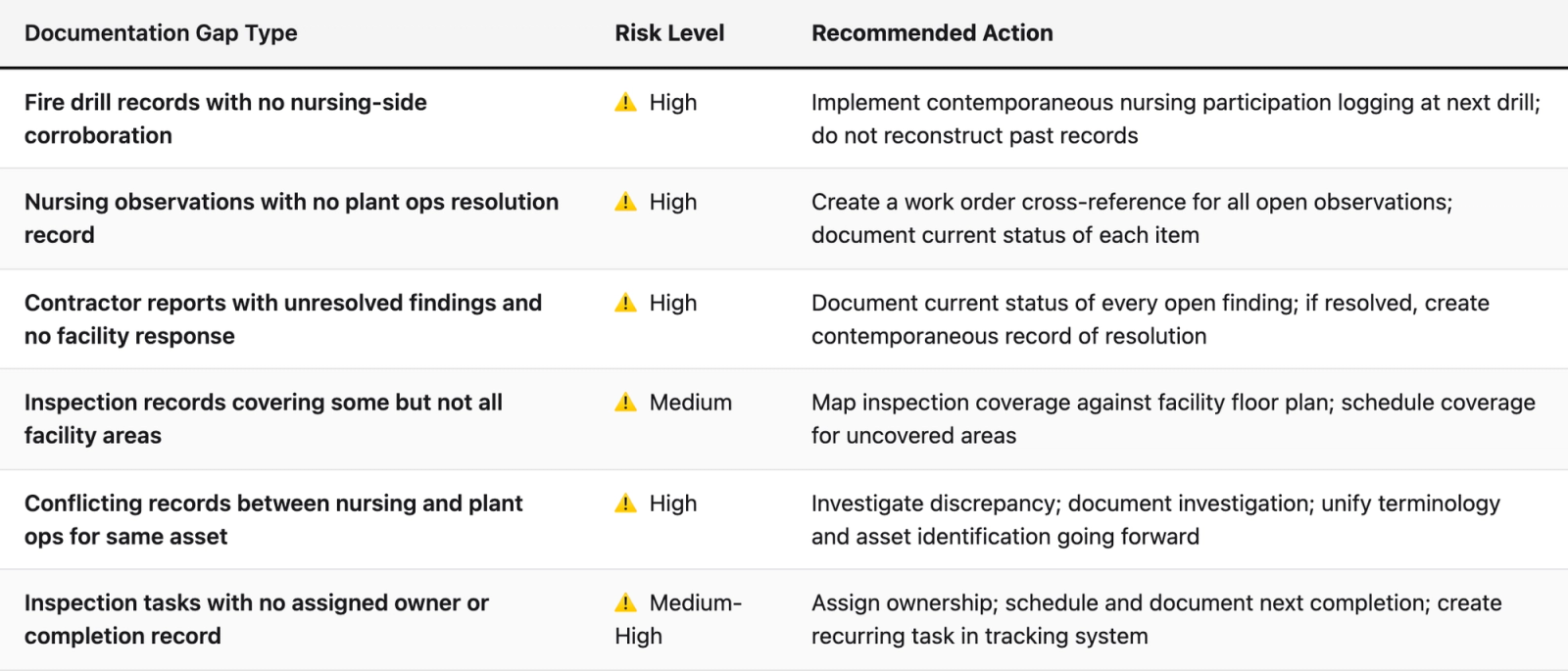
Using the results of steps 2 through 4, categorize your documentation gaps by life safety area. This gives you a priority list for remediation: the categories with the most gaps, or the gaps with the highest interdepartmental complexity, should be addressed first.
What the Gap Costs at Multi-Site Scale
For single-facility operators, the compliance accountability gap is a survey risk and a reputational risk. For multi-site SNF operators and regional chains, it is all of those things multiplied by the number of facilities in the portfolio, and it introduces an additional layer of risk: the inability to get an accurate, real-time picture of documentation status across the organization.
A regional director of facilities managing ten SNFs cannot physically review the nursing logs and plant ops binders at each facility on a meaningful schedule. They rely on self-reporting from each site. When the documentation gap exists at the facility level, self-reporting tends to be optimistic, not because facility staff are dishonest, but because the gap is invisible to the people operating within it. The nursing director thinks documentation is handled because nursing is logging observations. The plant ops director thinks documentation is handled because the binder is current. Neither person has visibility into the gap between their records.
At scale, this creates a portfolio-level compliance blind spot. Regional leadership does not know which facilities are at elevated survey risk until a survey happens and citations appear. By that point, the only options are reactive: plans of correction, documentation remediation, and the reputational and operational cost of a problematic survey outcome.
The facilities that manage this problem most effectively at scale have moved to a model where documentation status is observable from the regional or corporate level in real time. Not through manual reporting, but through a platform that aggregates documentation completion, flags open gaps, and surfaces facilities with elevated risk before a surveyor arrives. This is not a hypothetical technology, it is the operational model that platforms designed for multi-site SNF compliance are built to deliver.
Frequently Asked Questions
What is the compliance accountability gap in SNF environment of care?
The compliance accountability gap is the space between what nursing staff document about the physical environment and what plant operations staff document about the same environment. Because both departments observe and interact with the same spaces but maintain separate records, documentation chains are frequently incomplete, inconsistent, or irreconcilable. This gap creates citation risk when a surveyor cross-references both sets of records during a life safety survey.
Why do nursing and plant ops document the same environment differently?
The two departments have different documentation purposes, different reporting structures, and different tools. Nursing documentation is oriented toward patient safety observation and clinical accountability. Plant ops documentation is oriented toward scheduled inspection compliance and physical plant maintenance. Both interact with the same physical environment, but they record their interactions in ways that were not designed to be reconciled with each other.
Which life safety tasks are most affected by the interdepartmental documentation gap?
Fire drills carry the highest interdepartmental documentation risk, because they require nursing participation but are typically documented by plant ops or administration. Means of egress observations, fire door function, and hazardous area enclosure conditions also carry high gap risk because nursing staff typically observe problems while plant ops is responsible for resolution and documentation. Evacuation plan familiarity is another high-risk category because it requires both nursing knowledge and administrative documentation to align.
How do CMS surveyors identify documentation gaps between departments?
Surveyors request records from both departments during a life safety survey and cross-reference them against each other and against their physical observations. Discrepancies in fire drill participant counts, observation notes without corresponding resolution records, and inspection logs that cover some areas of a facility but not others are common signals that surveyors identify. Surveyors also interview nursing staff about their knowledge of emergency procedures and compare those accounts with the written records.
Can a facility reconstruct missing documentation after a gap is discovered?
Documentation of events that actually occurred, supported by other contemporaneous evidence, can be added to a facility's record with appropriate notation. However, creating records that purport to be contemporaneous when they are not, or creating records of events that cannot be verified as having occurred, raises serious credibility and integrity concerns during survey. Facilities should address documentation gaps going forward with contemporaneous logging rather than attempting to reconstruct past records.
Do life safety citations from K-tags affect a facility's Five-Star Quality Rating?
No. According to CMS's Five-Star Quality Rating System Technical Users' Guide, life safety survey deficiencies are not included in the Five-Star health inspection rating calculations. However, fire safety inspection results are posted separately on Care Compare and are visible to families, referral sources, and hospital discharge planners. The reputational impact of visible fire safety citations is real even when the Five-Star score is not directly affected.
What is the most common mistake facilities make when trying to fix the documentation gap?
The most common mistake is addressing the gap with a policy change rather than a systems change. Policies that require nursing to notify plant ops of observations, or require plant ops to cross-reference nursing logs, create the right intent but add documentation burden to already resource-constrained staff. Without a shared system of record that makes cross-referencing automatic, policy-based solutions erode quickly under operational pressure.
How should a facility prioritize fixing its documentation gaps?
Start with fire drill records, which carry the highest interdepartmental risk and are among the first items surveyors request. Then address nursing observations with no corresponding plant ops resolution record, followed by contractor reports with unresolved findings. These three categories address the highest-probability citation sources. Use the self-assessment framework in this article to inventory your current gaps before prioritizing remediation.
What role does SEQURA play in closing the interdepartmental documentation gap?
SEQURA provides a unified system of record for SNF environment of care documentation, where both nursing and plant ops staff log their activities through a shared platform. Scheduled inspection tasks are assigned and tracked to completion. Nursing observations generate linked work orders in the plant ops workflow. Fire drill records capture nursing participation contemporaneously. An AI review layer surfaces documentation gaps before survey by cross-referencing completed records against regulatory expectations for each life safety category.
Is the interdepartmental documentation gap a problem specific to paper-based systems?
Paper binders make the gap worse, but the gap can exist in digital systems too if each department is using a separate tool with no reconciliation mechanism. The problem is not paper versus digital. It is siloed versus unified. A facility using two separate software platforms, one for nursing documentation and one for plant ops work orders, may have exactly the same reconciliation problem as a facility using two paper binders. The solution is a unified system, not simply a digital one.
How does the documentation gap affect multi-site SNF operators differently than single-facility operators?
At single facilities, the gap is a survey risk and a reputational risk. At multi-site scale, it is also an operational visibility problem. Regional leadership cannot accurately assess survey risk across a portfolio if the documentation gap is invisible to facility-level staff. Multi-site operators need a platform that surfaces documentation status across all facilities in real time, not a self-reporting system that depends on each facility correctly identifying its own gaps.
What is the best way to test whether our current documentation is reconcilable?
Pull the most recent five fire drill records from plant ops and cross-reference them against any nursing documentation of those same drills. Compare participant counts, shift designations, dates, and scenario descriptions. Then pull ninety days of nursing environment of care observations and check each physical plant item against plant ops records for a corresponding work order or maintenance log entry. The number of mismatches and unresolved items is your documentation gap score.
Key Takeaways
- The compliance accountability gap is structural, not behavioral. Nursing and plant ops staff are not failing to do their jobs. They are maintaining separate documentation systems that were never designed to produce a unified, surveyable record of the shared environment.
- Fire drills, egress observations, fire door function, and hazardous area conditions carry the highest interdepartmental documentation risk because they require both nursing observation and plant ops response to produce a complete compliance record.
- CMS surveyors cross-reference records from both departments. Discrepancies between nursing logs and plant ops binders for the same asset or event create citation opportunities that the facility cannot explain away after the fact.
- Policy changes alone do not close the gap. Without a shared system of record and an automated reconciliation mechanism, cross-departmental documentation requirements erode under operational pressure.
- Scope matters as much as severity. A pattern of interdepartmental documentation gaps across multiple life safety categories is evaluated differently than an isolated deficiency. The gap creates pattern-level risk, not just individual citation risk.
- Life safety citations are publicly visible on Care Compare even though they do not count toward the Five-Star health inspection rating. The reputational impact on referral relationships is real regardless of scoring.
- Multi-site operators face a portfolio visibility problem in addition to the citation risk. Without a centralized documentation platform, regional leadership cannot accurately assess survey readiness across facilities.
- The self-assessment framework in this article gives facilities a starting point for inventorying their current gaps before implementing a systemic solution. Fire drill cross-referencing and nursing observation review are the highest-priority audit steps.
- A unified documentation platform closes the gap by giving both departments a shared system of record, linking nursing observations to plant ops work orders, and surfacing documentation gaps through automated review before a surveyor arrives.
About the author
Benjamin Terebelo · Founder
Benjamin is the founder of SEQURA, a compliance platform purpose-built for healthcare facilities. He builds at the intersection of healthcare operations and software, maintaining a focus on bringing modern tooling to systems that the broader industry has largely left behind.
Related reading
About the author
Benjamin Terebelo · Founder
Benjamin is the founder of SEQURA, a compliance platform purpose-built for healthcare facilities. He builds at the intersection of healthcare operations and software, maintaining a focus on bringing modern tooling to systems that the broader industry has largely left behind.
Topics
- SNF compliance accountability
- environment of care documentation
- nursing vs plant ops compliance
- K-tag accountability gap
- SNF interdepartmental compliance


