26 min read
What Is a Life Safety Risk Register — And Why Every SNF Compliance Officer Needs One
A life safety risk register centralizes K-tag exposure, inspection gaps, and deficiency trends. Learn why SNF compliance officers treat it as a survey survival tool.
By Benjamin Terebelo

Most skilled nursing facilities have the documentation. The inspection logs are somewhere. The fire drill records exist. The generator test was completed. The problem is that "somewhere" is not a compliance strategy, and "completed" is not the same as "documented in a way that survives surveyor scrutiny." The life safety risk register exists to close that gap, and for SNF compliance officers who have lived through an unannounced CMS visit, it is one of the most operationally significant tools they can build.
This article explains what a life safety risk register actually is, why it functions differently from a standard compliance checklist, how it maps to the K-tag structure CMS surveyors use, and what a well-built register looks like in practice. It also addresses the prioritization problem that most facilities get wrong, and why the SNF compliance officer, not the maintenance director, needs to own the register's logic, even if they never touch a wrench.
What a Life Safety Risk Register Actually Is (Not What Most People Think)
A life safety risk register is a structured, living document that catalogues every known or reasonably anticipated life safety risk at a facility, assigns each risk a severity and likelihood score, maps it to the regulatory consequence if left unresolved, and tracks the remediation or mitigation status over time. That definition sounds similar to a deficiency log or a corrective action plan, but the differences are operationally significant.
A deficiency log records what went wrong after a survey. A corrective action plan documents how the facility will fix a cited deficiency. A life safety risk register operates before either of those things happens. Its entire purpose is to surface exposure that has not yet been cited, so the facility can address it on its own timeline rather than on a surveyor's timeline.
The distinction matters because CMS life safety surveys are unannounced. A facility that waits for a deficiency citation to begin thinking about its sprinkler documentation gaps, its fire door inspection records, or its emergency generator test logs is already in a reactive posture. The risk register shifts the facility into a pre-survey posture, where the compliance officer already knows which documentation gaps exist, how serious they are, and what the remediation plan is.
In practice, a life safety risk register typically contains the following elements for each identified risk:
- Risk description: A plain-language statement of what the gap or exposure is (e.g., "quarterly fire door inspection records are incomplete for the east wing corridor").
- K-tag category: The CMS life safety tag category the gap maps to, described in plain language rather than by a code number that may be misapplied without a linked source (e.g., "fire door assembly inspection and maintenance").
- Likelihood score: How probable it is that this gap would be identified by a surveyor conducting a standard life safety survey.
- Severity score: The potential regulatory consequence if cited, ranging from no actual harm to immediate jeopardy potential.
- Composite risk score: Likelihood multiplied by severity, used to sequence remediation priorities.
- Remediation owner: The specific person accountable for resolving the gap, with a name, not a title.
- Target resolution date: A committed date, not an open-ended "as soon as possible."
- Current status: Open, in progress, resolved, or accepted risk with rationale.
- Evidence of resolution: A link or reference to the documentation that closes the gap.
What separates a functioning risk register from a spreadsheet that collects dust is the last two columns. A risk register without evidence linkage is just a list. The moment you can pull up a completed inspection log, a contractor report, or a dated work order as evidence of resolution, the register becomes a survey defense tool rather than an internal planning document.
Why the K-Tag Structure Makes a Risk Register Non-Optional
CMS life safety surveys at skilled nursing facilities follow the K-tag framework, a set of regulatory tags derived from the NFPA 101 Life Safety Code and NFPA 99 Health Care Facilities Code, as adopted by CMS through its Life Safety Code requirements. Each K-tag corresponds to a specific life safety requirement, and citations are recorded against specific tags rather than as general findings.
The K-tag structure creates a compliance mapping problem that is genuinely difficult to manage without a register. There are dozens of distinct K-tag categories covering everything from construction and compartmentation to means of egress, fire alarm systems, sprinkler systems, emergency power, and hazardous areas. Each category has its own inspection cadence, documentation format, and evidence standard. Some require monthly checks. Some require annual contractor inspections. Some require testing under specific load conditions. Some require that deficiencies discovered during inspections be tracked to resolution.
The compliance officer who tries to hold all of this in their head, or who relies on the maintenance director's binder as their primary assurance mechanism, is working with a fundamentally inadequate system. The binder might contain the completed inspection forms. It almost certainly does not contain a cross-referenced view of which forms are missing, which inspection cycles have lapsed, which contractor reports have open deficiencies that were never closed, and which of those open deficiencies maps to a K-tag category with elevated survey risk.
A life safety risk register solves this by providing exactly that cross-referenced view. When built correctly, the register answers the question a CMS surveyor is effectively asking during every life safety survey: "For each K-tag category, does this facility have complete, contemporaneous documentation that the required inspections and maintenance activities were performed?" The register tells the compliance officer, before the surveyor walks in, where the answer to that question is "no" or "not clearly."
The Documentation Standard That Trips Most Facilities
It is worth being specific about what "complete, contemporaneous documentation" means in the life safety context, because this is where many SNFs have significant exposure they are not aware of.
Contemporaneous documentation means records created at or near the time the inspection or maintenance activity occurred, not assembled after the fact. A fire drill log that is filled in the day after the drill, a generator test record that is transcribed from handwritten notes into a clean form a week later, or a sprinkler inspection report that is filed two months after the contractor visit, all carry elevated survey risk not because the underlying activity was not performed, but because the documentation pattern raises questions about accuracy and reliability.
CMS surveyors review documentation alongside their physical observations. When a surveyor walks a corridor and observes a fire door that does not latch properly, then reviews the door inspection log and finds the door listed as "satisfactory" on the most recent inspection date, the documentation does not help the facility. It creates a second problem on top of the first. The risk register's job is to surface situations like this before the survey, when the facility still has time to re-inspect, correct the record, or document the remediation.
How SNF Compliance Officers Use the Register Differently Than Maintenance Directors
The SNF compliance officer and the maintenance director are both essential to a functional life safety program, but they interact with the risk register in fundamentally different ways. Understanding that difference is important for building a register that actually works.
The maintenance director's relationship with life safety is operational. They schedule inspections, assign technicians, coordinate contractors, and manage the physical plant. Their primary concern is whether the work gets done. A maintenance director who is diligent about their job produces completed inspection forms, contractor reports, and work orders. What they are typically not positioned to do is evaluate whether that completed documentation would survive a CMS surveyor's review, because that evaluation requires knowledge of the regulatory standards, the K-tag framework, and the scope and severity criteria CMS uses to assess deficiencies.
The compliance officer's relationship with life safety is regulatory. They are accountable for whether the facility's documentation meets the evidentiary standard CMS applies during a survey. They need to know not just whether an inspection was completed, but whether the documentation of that inspection is complete, whether the inspection cadence matches the regulatory requirement, whether deficiencies discovered during the inspection were tracked to resolution, and whether the overall pattern of documentation across all K-tag categories would hold up under systematic review.
The life safety risk register is the tool that connects those two roles. The maintenance director's operational records feed the register. The compliance officer's regulatory knowledge shapes the register's scoring, prioritization, and remediation standards. Without the register as a connective layer, the two roles operate in parallel without meaningful integration, and the facility's survey readiness is only as good as the maintenance director's individual judgment about what matters.
The Compliance Officer's Four Core Register Functions
In practical terms, the SNF compliance officer typically uses the life safety risk register to perform four functions:
- Gap identification: Systematically reviewing all K-tag categories to identify documentation gaps, lapsed inspection cycles, and open deficiencies. This is the register's primary value and should happen on a defined schedule, not opportunistically.
- Risk prioritization: Scoring each identified gap based on its regulatory consequence and likelihood of surveyor detection, then sequencing remediation based on that scoring. This prevents the common mistake of spending limited remediation bandwidth on low-consequence gaps while higher-consequence gaps remain open.
- Remediation tracking: Assigning ownership and deadlines for each open item, then tracking progress to resolution with evidence. This creates accountability that a verbal check-in with the maintenance director does not provide.
- Survey preparation: Using the register as a pre-survey readiness assessment tool, identifying any remaining open items in the weeks before a scheduled survey (or as a standing practice, given that CMS surveys are unannounced).
Building a Prioritization Model That Is Actually Safe
Risk scoring is where most life safety risk registers get built incorrectly, and where the consequences of getting it wrong are most serious. The standard risk matrix approach, multiplying a likelihood score by an impact score to produce a composite, is a reasonable framework, but it requires careful calibration in the life safety context.
The core problem is this: in a standard risk matrix, a low-likelihood, high-impact risk and a high-likelihood, low-impact risk can produce the same composite score and end up in the same priority queue. In most business contexts, that is an acceptable approximation. In the life safety context, it can be dangerous prioritization.
Consider two scenarios. In the first, a facility has a gap in its generator load-test documentation, specifically a missing kilowatt reading from a single test in the past year. The gap is low-likelihood to produce immediate jeopardy, but if a surveyor identifies it, it creates a citation in the fire protection and life safety category. In the second scenario, a facility has an emergency exit in an infrequently used corridor that has never been included in the fire drill rotation. That gap has a different risk profile entirely, because it bears on whether occupants can safely evacuate that section of the building.
A composite scoring model that treats these two risks as equivalent based on their numerical score, and assigns both to the same 30-day remediation queue, is not safe prioritization. The fix is to build explicit override logic into the register: any risk that touches occupant safety rather than documentation compliance gets elevated to immediate attention regardless of its composite score. Any risk with potential immediate jeopardy consequences gets the same treatment.
A Practical Scoring Framework for SNF Risk Registers
The following framework is designed specifically for skilled nursing facility life safety risk registers, with the override logic built in from the start. It is not a CMS-prescribed methodology; it is a practical operating model that can be adapted to a facility's specific circumstances.
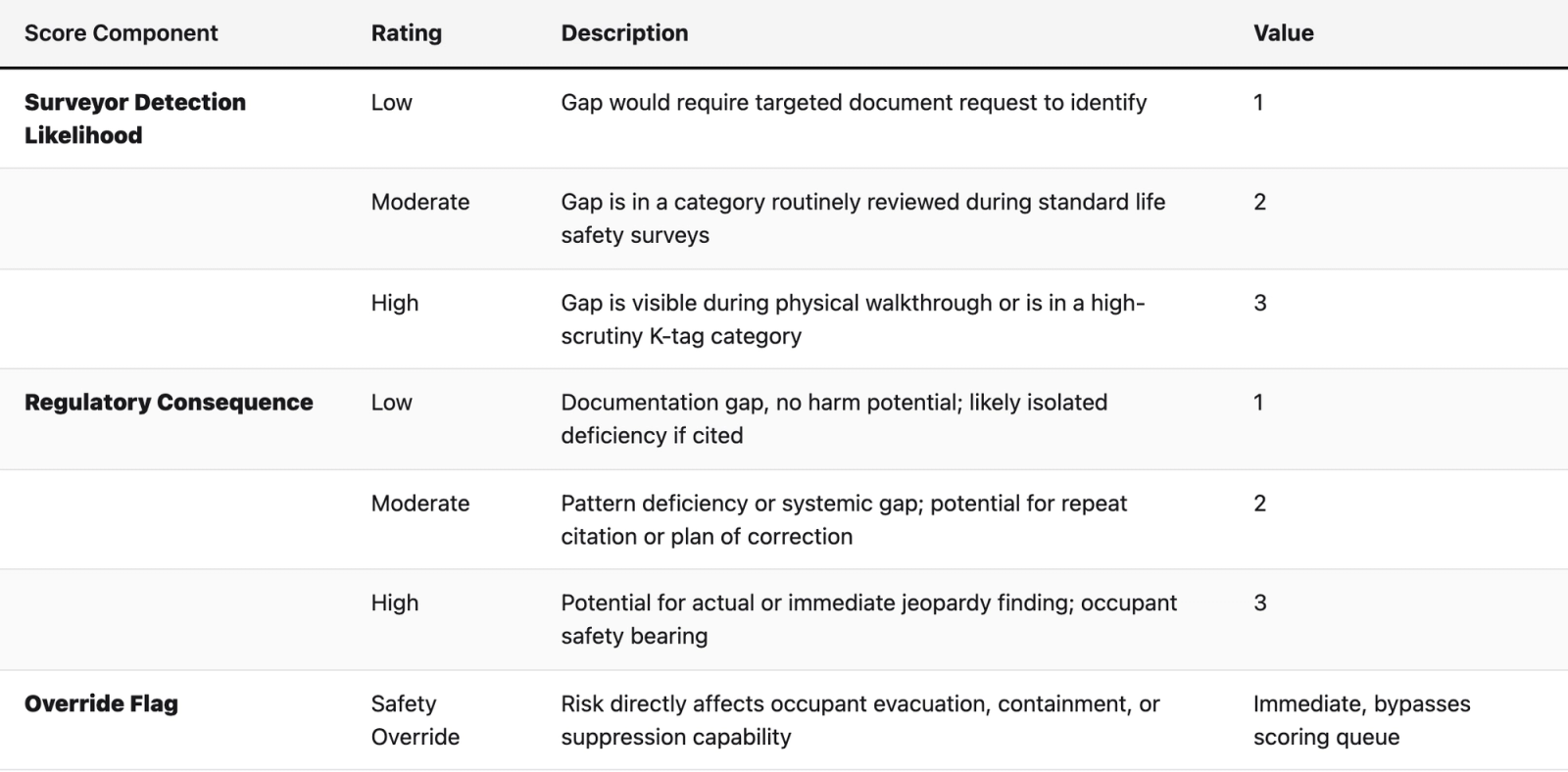
Under this model, composite scores of 6–9 (high likelihood, high consequence) get immediate attention regardless of remediation complexity. Composite scores of 3–5 are scheduled for resolution within 30 days, with weekly check-ins. Composite scores of 1–2 are logged and monitored but may be deferred if remediation bandwidth is constrained. The override flag ensures that any risk with a direct bearing on occupant safety during a fire or other life safety emergency is escalated to immediate status regardless of its composite score.
This is not a mechanical formula. Experienced compliance officers use the scoring as a starting point and apply judgment based on their knowledge of the facility, the specific gap, and the current survey environment. The value of the framework is not that it removes judgment. It is that it makes the judgment process systematic and defensible.
The K-Tag Categories That Generate the Most Survey Exposure
While every K-tag category carries compliance risk, certain categories generate disproportionate survey exposure at skilled nursing facilities, either because they involve frequent inspection cadences with complex documentation requirements, or because physical conditions are easily observable during a walkthrough, or both. The following overview covers the categories where a life safety risk register adds the most immediate value.
Fire Door Assemblies and Corridor Integrity
Fire door inspections are among the most frequently cited life safety categories at SNFs. The requirements, derived from NFPA 80 as adopted through the Life Safety Code, call for annual inspection of every fire door assembly by a qualified inspector, with each door individually documented. The scale of that requirement at a typical SNF, where there may be dozens or hundreds of fire doors across multiple corridors, smoke compartments, and stairwells, creates significant documentation volume and corresponding documentation risk.
The most common gap is not that the inspections were skipped. It is that the documentation is incomplete: doors that were inspected but not individually listed, deficiencies that were noted but not tracked to resolution, or contractor reports that cover some doors but not all. A risk register entry for this category should capture not just whether the annual inspection was completed, but whether every door is individually documented, whether any deficiencies are open, and when the next inspection is due.
Automatic Sprinkler Systems
Sprinkler system inspection, testing, and maintenance requirements are derived from NFPA 25, as adopted through the Life Safety Code, and involve a layered cadence of inspections at different intervals, from monthly visual checks to quarterly, annual, and multi-year testing and maintenance activities. The documentation requirement for each layer is distinct, and the records must be retained and accessible.
The risk register entry for sprinkler systems should address each inspection layer separately, because the documentation gaps that produce citations are often layer-specific. A facility might have clean annual inspection records from its contractor but missing monthly visual inspection logs, or it might have complete inspection records but open deficiencies from a quarterly test that were never tracked to resolution. Each of those is a separate risk register entry with its own remediation owner and timeline.
Fire Alarm Systems
Fire alarm system requirements similarly involve a layered inspection and testing cadence, with different components tested at different intervals. The documentation challenge is compounded by the fact that fire alarm systems involve multiple components, including detectors, pull stations, notification appliances, and the control panel itself, each with potentially distinct testing requirements.
A common risk register gap in this category is the "partial test" problem: a contractor performs and documents some components of the required annual testing but not others, and the facility's documentation review does not catch the omission. The risk register should require that the compliance officer or a designated reviewer verify that contractor reports cover all required components, not just that a contractor report exists.
Emergency Power Systems
Emergency power supply system requirements are derived from NFPA 110, as adopted through the Life Safety Code, and require documented testing at defined intervals under load conditions specified in the standard. The documentation must capture specific performance data, including load levels, to demonstrate compliance with the testing standard.
The risk register entry for emergency power should flag any test record that is missing required performance data, not just any test that was missed entirely. A generator test log that records "test completed" without the required load data is a documentation gap that a surveyor may identify during record review, even if the generator itself is in perfect working condition. This is a category where the gap between "the work was done" and "the documentation supports compliance" is particularly common.
Fire Drills and Staff Training
Fire drill requirements at SNFs specify both the frequency and the shift distribution of drills. Drills must be conducted on each shift and across all quarters of the year, and the documentation must reflect that distribution. The most common citation pattern in this category involves drills that were conducted but not distributed across all required shifts, or documentation that does not clearly capture the shift, time, and participating staff count for each drill.
The risk register entry for this category should include a drill matrix, a simple grid showing the required drills by quarter and shift alongside the documented drills, so that the compliance officer can see at a glance whether the distribution requirement is being met. This is one of the most straightforward risk register entries to build and one of the highest-value, because fire drill gaps are among the most consistently cited findings at SNF life safety surveys.
How the Register Connects to CMS Survey Readiness
CMS life safety surveys at skilled nursing facilities follow a defined protocol. Surveyors conduct a physical walkthrough of the facility, observe conditions, and review documentation. The documentation review is systematic: surveyors request specific categories of records and evaluate them against the requirements for each K-tag category. A facility that cannot produce complete, organized documentation for a requested category is at elevated risk of citation regardless of whether the underlying inspections were performed.
The life safety risk register directly supports survey readiness in three ways that a standard compliance checklist does not.
First, the register creates a pre-survey audit trail. When a surveyor arrives and requests fire door inspection records, the compliance officer who has a functioning risk register already knows whether those records are complete, whether any deficiencies are open, and what the status of any remediation is. That knowledge does not change what the surveyor finds, but it allows the compliance officer to respond to questions accurately and confidently, and to produce organized documentation efficiently.
Second, the register surfaces systemic gaps before they become pattern findings. A single missing monthly sprinkler inspection log is a documentation gap. Three missing monthly logs across the same quarter is a pattern. A surveyor who identifies a pattern has grounds for a finding with broader scope than an isolated deficiency, and broader scope can affect the remediation requirements the facility faces. The risk register, by tracking all gaps in a given category together, makes patterns visible before the survey so the facility can address them as a systemic issue rather than discovering them as a survey finding.
Third, the register supports the plan of correction process. When a citation does occur, the facility must submit a plan of correction that demonstrates it understands the root cause of the deficiency and has implemented measures to prevent recurrence. A compliance officer with a functioning risk register can produce a credible, specific plan of correction quickly, because the register already contains the gap analysis and remediation tracking that the plan of correction is supposed to demonstrate.
The Register as a Living Document, Not a Point-in-Time Snapshot
One of the most common mistakes facilities make when they first build a life safety risk register is treating it as a project with a completion date. They build the register, populate it with current gaps, assign remediation owners, and then stop updating it once the cited gaps are closed. Six months later, the register is out of date, new gaps have accumulated, and the facility is back in a reactive posture.
A functioning life safety risk register is a living document with a defined update cadence. At a minimum, the register should be reviewed and updated monthly, with immediate updates triggered by any new inspection, contractor report, or survey activity. The compliance officer should review the full register quarterly to assess whether the scoring and prioritization remain accurate, and to identify any categories that have not had a review entry in the previous 90 days.
The monthly update cycle should be tied to the facility's inspection calendar. When a monthly sprinkler visual is completed, the register entry for that inspection cycle is updated with the completion date and the documentation reference. When an annual fire alarm test is conducted and the contractor report is received, the register entry for that category is updated with the report date, the components covered, any deficiencies noted, and the open deficiency status. The register is only as current as its last update, and its value as a survey readiness tool depends entirely on that currency.
Multi-Site Operators and the Aggregation Problem
For compliance officers who support multiple SNF locations, whether as a regional compliance director, a VP of operations, or a life safety consultant working across a portfolio, the life safety risk register concept scales to a portfolio view, but it requires deliberate architecture to do so effectively.
The most common multi-site failure mode is parallel but disconnected registers at each facility. Each facility maintains its own register, each register uses a slightly different scoring methodology, and the regional compliance officer has no reliable way to aggregate findings across the portfolio to identify common gaps, high-risk facilities, or systemic patterns that might indicate a training or process failure rather than a facility-specific issue.
A portfolio-level risk register architecture addresses this by standardizing the register format, scoring methodology, and K-tag category mapping across all facilities, while maintaining facility-specific entries. This allows the regional compliance officer to pull a cross-facility view that shows, for example, which facilities have open fire door deficiencies, which have gaps in their drill documentation, and which have the highest composite risk scores, without having to manually reconcile differently formatted spreadsheets from each location.
The portfolio view also supports resource allocation decisions. When remediation bandwidth is limited, whether in terms of staff time, contractor availability, or capital, the regional compliance officer can use the aggregated register to prioritize remediation at the highest-risk facilities rather than allocating resources equally across a portfolio where the risk is not equally distributed.
Common Ownership Scrutiny and What It Means for Register Design
Facilities under common ownership or management can attract heightened regulatory attention when patterns of deficiency are identified at multiple locations. While there is no established CMS mechanism for automatically aggregating deficiency patterns across a chain and applying chain-level enforcement based on that aggregation, CMS has authority to consider common ownership in its oversight activities, and state survey agencies may coordinate their survey activities across commonly owned facilities when patterns of concern are identified.
For the compliance officer at a multi-site operator, this means the risk register architecture should be designed to support not just individual facility readiness, but portfolio-level pattern detection. If the same K-tag category is generating gaps at three out of five facilities in a regional portfolio, that is a signal of a systemic process or training issue, not three independent facility problems. The risk register is the tool that makes that signal visible.
Integrating the Risk Register with Operational Workflows
A life safety risk register that exists as a standalone spreadsheet, maintained by the compliance officer in isolation from the facility's operational workflows, will always be incomplete. The register's accuracy depends on timely, accurate information about what inspections have been completed, what deficiencies have been found, and what remediation has occurred. That information lives in the operational layer, with the maintenance director, the contracted inspection firm, and the technicians who perform the work.
Effective integration means building a data flow from the operational layer to the register, so that the compliance officer is not dependent on manually chasing updates from the maintenance team. In practice, this requires three things:
Standardized documentation formats: Inspection logs, contractor reports, and work orders should capture the specific data points the risk register needs: the inspection date, the components covered, any deficiencies noted, and the deficiency resolution status. A contractor report that says "annual inspection completed, satisfactory" does not give the compliance officer enough information to update the register accurately.
Defined handoff points: The process for getting completed documentation from the operational layer to the compliance officer should be defined and consistently followed. This might mean a weekly documentation review meeting, a shared digital folder where completed inspection records are deposited, or an automated workflow in a compliance platform. The specific mechanism matters less than the consistency.
Exception reporting: The compliance officer should not have to review every completed inspection log to identify problems. The operational workflow should include an exception-reporting step: when an inspection reveals a deficiency, or when an inspection is not completed on schedule, a notification goes to the compliance officer. This keeps the compliance officer focused on the gaps rather than the routine completions.
Where Technology Changes the Equation
The integration challenge described above is exactly the problem that purpose-built life safety compliance platforms, including SEQURA, are designed to solve. Rather than relying on a paper binder and a manual handoff process, platforms in this category digitize the inspection logging process, automate the inspection schedule and assignment, and surface documentation gaps through systematic review of completed records.
The practical effect on the risk register is significant. When inspection logs are captured digitally at the point of completion, whether via a facility kiosk, a mobile device, or a back-office computer, the data is immediately available for compliance review rather than sitting in a binder waiting to be reviewed. When an AI review layer cross-references completed records against regulatory expectations for each K-tag category, documentation gaps are surfaced automatically rather than requiring the compliance officer to manually audit every record.
This does not replace the risk register. It makes the risk register more accurate, more current, and more complete. The compliance officer still needs to own the risk scoring, the prioritization logic, and the remediation tracking. What technology eliminates is the manual documentation audit, which is the most time-consuming and error-prone part of maintaining a functioning register.
The Risk Register as a Communication Tool for Leadership
SNF compliance officers often face a communication challenge with facility administrators and ownership: how to convey the seriousness of life safety compliance gaps without either understating the risk (which leads to under-resourcing) or overstating it (which leads to alarm without productive action). The life safety risk register, formatted appropriately, is one of the most effective tools for bridging that communication gap.
A risk register summary report, showing the number of open items by K-tag category, the composite risk scores, and the remediation status, gives facility leadership a clear, quantified picture of the facility's current life safety exposure without requiring them to understand the details of the NFPA 101 inspection cadence or the CMS scope and severity framework. The composite score communicates relative risk in terms that translate directly to administrative priority: high-score items need resources and attention now, lower-score items can be managed on a longer timeline.
For administrators who are accountable for survey outcomes but not directly involved in the day-to-day life safety program, the risk register summary also provides a mechanism for oversight without micromanagement. The administrator can review the monthly summary, ask about any open high-score items, and hold the compliance officer accountable for progress without needing to be in the weeds of individual inspection records.
At the ownership level, the risk register supports capital planning conversations. When a fire door replacement program, a sprinkler system upgrade, or an emergency power system enhancement is needed, the risk register entry for that category, showing the current gap, the regulatory consequence, and the cost of remediation, makes the business case in a language that ownership understands: regulatory risk, remediation cost, and timeline.
Frequently Asked Questions
What is the difference between a life safety risk register and a corrective action plan?
A corrective action plan is reactive: it documents how a facility will fix a deficiency that has already been cited by a surveyor. A life safety risk register is proactive: it identifies and tracks gaps before they are cited, so the facility can remediate on its own timeline. The two documents serve different purposes and should both exist at a well-managed SNF.
Who should own the life safety risk register at an SNF?
The SNF compliance officer should own the risk register's logic, scoring methodology, and remediation tracking. The maintenance director should provide operational data that feeds the register, including completed inspection logs, contractor reports, and work orders. The administrator should receive regular summary reports and be accountable for ensuring remediation resources are available.
How often should the risk register be updated?
At a minimum, the register should be reviewed and updated monthly, with immediate updates triggered by any new inspection, contractor report, or survey activity. The full register should be reviewed quarterly to assess whether scoring and prioritization remain accurate and whether any categories have gone without a review entry in the previous 90 days.
Does a life safety risk register need to cover all K-tag categories, or just the high-risk ones?
A complete register covers all K-tag categories, not just the ones the facility considers high-risk. Categories the facility views as low-risk may not be low-risk from a surveyor's perspective, and an incomplete register creates blind spots. That said, the scoring methodology allows the compliance officer to invest more remediation effort in higher-risk categories while monitoring lower-risk ones with a lighter touch.
Can the risk register be used as evidence during a CMS survey?
The risk register itself is an internal compliance management document and is not typically presented directly to surveyors. However, the evidence of resolution linked within the register, the completed inspection logs, contractor reports, and work orders, is exactly the documentation surveyors request. A well-maintained register makes it faster and easier to produce that documentation in an organized, complete format.
How does the risk register relate to the NFPA inspection requirements?
The risk register maps each facility's life safety documentation gaps to the specific K-tag categories that correspond to NFPA 101 and NFPA 99 requirements as adopted by CMS. The register does not replace the NFPA inspection requirements; it tracks the facility's compliance with those requirements and identifies where documentation gaps exist. The NFPA 101 Life Safety Code is the foundational standard for most of the K-tag requirements the register addresses.
What is the biggest mistake SNFs make when building a life safety risk register?
The most common mistake is treating the register as a point-in-time project rather than a living document. Facilities build a register in response to a survey finding or a compliance initiative, close the initial gaps, and then stop updating the register. Within a few months, new gaps have accumulated, and the register is no longer an accurate picture of the facility's risk exposure.
How does a life safety risk register support fire drill compliance?
The risk register entry for fire drills should include a drill matrix showing the required drills by quarter and shift alongside the documented drills. This makes it immediately visible whether the distribution requirement is being met, which is the most common gap in fire drill compliance. The compliance officer can identify a missing shift or quarter at a glance rather than manually reviewing individual drill logs.
Does a multi-site operator need a separate register for each facility?
Each facility should have its own register with facility-specific entries, because the gaps and risk profiles differ by location. However, a multi-site operator benefits from standardizing the register format, scoring methodology, and K-tag category mapping across all facilities so that the regional compliance officer can aggregate findings and identify portfolio-level patterns. The two levels, facility and portfolio, serve different but complementary purposes.
How should the risk register handle deficiencies found during contractor inspections?
Any deficiency noted in a contractor inspection report should generate a risk register entry with its own remediation owner, target resolution date, and evidence-of-resolution requirement. The most common gap in this area is that contractor-identified deficiencies are noted but not tracked to resolution, leaving open deficiencies that a surveyor may identify during record review. The risk register closes that tracking gap.
What is the relationship between the life safety risk register and CMS survey readiness?
The risk register is the primary tool for maintaining survey readiness in the life safety domain. It provides the compliance officer with a current, cross-referenced view of all K-tag documentation gaps, so that the facility's survey readiness posture is known and managed rather than assumed. Facilities with functioning risk registers are better positioned to respond to surveyor document requests quickly and accurately, and to demonstrate a systematic approach to life safety compliance.
How does technology like SEQURA support the risk register process?
Platforms like SEQURA digitize the inspection logging and scheduling process and apply an AI review layer that cross-references completed records against K-tag documentation expectations, surfacing gaps automatically. This makes the risk register more accurate and current by eliminating the manual documentation audit. The compliance officer still owns the risk scoring and remediation logic; technology eliminates the most time-consuming and error-prone parts of maintaining a complete, up-to-date register.
Key Takeaways
- A life safety risk register is a pre-survey tool, not a post-citation response. Its value lies in identifying and remediating documentation gaps before a CMS surveyor finds them.
- The SNF compliance officer, not the maintenance director, should own the register's logic, because survey readiness requires regulatory knowledge that the operational role typically does not include.
- Prioritization requires override logic. Any risk with a direct bearing on occupant safety during a fire or other life safety emergency should be elevated to immediate status regardless of its composite score.
- The register must be a living document with a defined monthly update cadence tied to the facility's inspection calendar. A register that is not regularly updated provides false assurance.
- Multi-site operators benefit from standardized register architecture across all facilities, enabling portfolio-level pattern detection and resource allocation decisions.
- Technology eliminates the manual documentation audit but does not replace the compliance officer's judgment on risk scoring, prioritization, and remediation tracking.
- Evidence of resolution is what turns a risk register into a survey defense tool. Every closed item should be linked to specific documentation that demonstrates the gap was addressed.
- The register is an effective leadership communication tool, translating technical compliance gaps into quantified risk scores and remediation timelines that administrators and ownership can act on.
Putting the Register to Work Before the Next Unannounced Visit
CMS life safety surveys at skilled nursing facilities arrive without notice. The compliance officer who waits for a survey to understand the facility's K-tag exposure has already lost the most valuable thing a risk register provides: time. Time to re-inspect a fire door that was incorrectly documented. Time to track a contractor-identified sprinkler deficiency to resolution. Time to fill in the missing shift on a fire drill matrix. Time to ensure that the generator test record contains the load data the standard requires.
Building a life safety risk register is not a complex project. It requires a clear K-tag category framework, a scoring methodology with appropriate override logic, a defined update cadence, and a commitment to linking every closed item to its evidence of resolution. What it requires most is ownership: a compliance officer who treats the register as a core responsibility rather than an administrative task, and who has the operational integration to keep it current.
For SNFs that are replacing paper binders with digital compliance platforms, the register becomes more accurate and more current automatically. For SNFs that are still managing life safety documentation manually, the register is the structure that makes manual management defensible. Either way, the register is the difference between knowing the facility's survey exposure and guessing at it. In an unannounced survey environment, that difference matters.
About the author
Benjamin Terebelo · Founder
Benjamin is the founder of SEQURA, a compliance platform purpose-built for healthcare facilities. He builds at the intersection of healthcare operations and software, maintaining a focus on bringing modern tooling to systems that the broader industry has largely left behind.
Topics
- life safety risk register
- SNF compliance officer
- CMS survey readiness
- K-tag risk management
- healthcare facility compliance


